A manufacturer's breakdown of what actually moves the cost of HEPA replacement filters for overseas B2B buyers: filter construction, media and frame, sealing, packaging, order quantity, freight, and who carries spare stock. No price list, just the cost elements to put in a quotation request.
"How much do air filters cost" is rarely answered usefully with a single number. Two buyers can order the same purifier and pay very different amounts for the replacement filter, because the filter is where most of the long-term cost of an air purifier program sits. This article gives you the cost structure instead of a price list: what moves the unit cost, which parts of the cost are one-time and which stay in every reorder, and what to ask a replacement filter supplier to quote separately so you can compare offers line by line.
Key takeaways
- Filter cost is built from construction, media, frame, sealing, packaging, order quantity, freight and stock holding, not from a single "filter price".
- One-time program costs (tooling, artwork, approval samples) sit outside the repeat cost your end user eventually pays.
- The same purifier can carry different filter prices from different suppliers mainly because of what each quote includes.
- Ask for a breakdown, not a blanket number. We give you the list of cost elements to request below.
Start with the filter itself, not the price
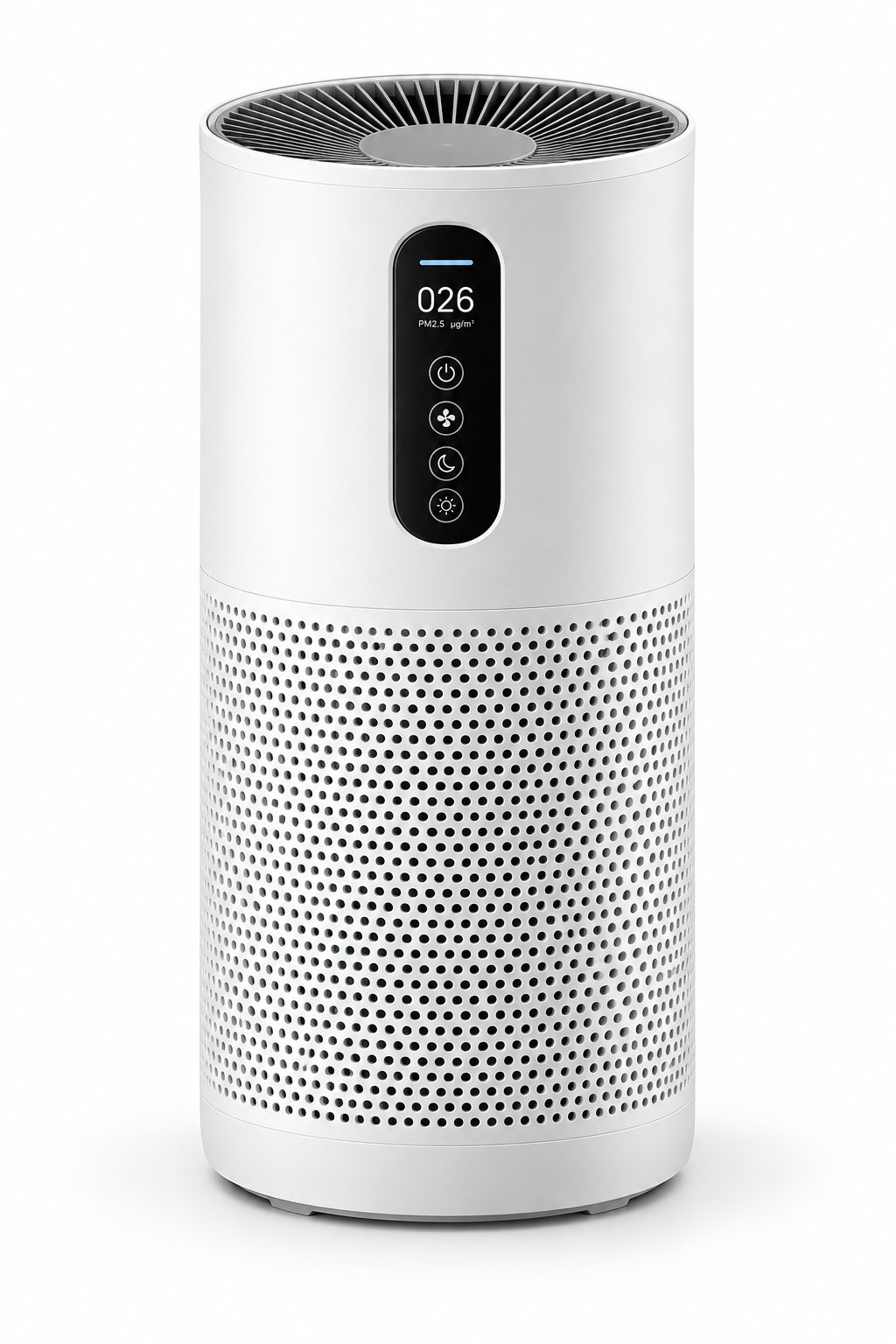
On the 200m³/h HEPA Air Purifier with Real-Time Air Quality Display (model ZY-AP1200), the filter is a replaceable HEPA plus activated carbon unit, and the unit covers rooms up to 25 m² at a CADR of 200 m³/h. That sentence already contains the first cost driver: a combined HEPA and carbon filter has more material layers than a HEPA-only filter, and every layer has its own supply cost. The purifier also has a replaceable filter by design, which means the filter is a separate item your program will keep buying for as long as the purifier stays in the field.
For an importer or private-label buyer, treat the filter as a repeat-purchase part with its own bill of materials. The purifier is a one-time sale; the filter is the recurring one.
What actually moves the cost of a replacement filter
Filter construction and filter stages
The number of stages is the first lever. A single HEPA stage and a HEPA-plus-activated-carbon stack do not share a cost base: the carbon layer adds media, adds thickness, and changes how the filter is assembled into its frame. If a program later adds a pre-filter or a separate carbon stage, expect the construction cost to move with it.
Media and frame
Media grade, pleat count and total media area determine how much filter paper goes into one unit, and filter paper is usually quoted by area or by weight. The frame material and its moulding or assembly method set the second part of the cost. A frame that needs a dedicated mould carries a tooling cost that is paid once; a frame built from standard profiles does not, but may cost more per unit.
Sealing and assembly
Sealing is small in material terms and large in quality terms. The way the media is bonded to the frame, and whether the perimeter is sealed, affects both the assembly time per unit and how consistently the batch performs. Assembly time is labour, and labour is a real line in the cost, especially in lower order quantities where setup is spread over fewer units.
Packaging and carton size
Replacement filters usually ship as standalone items, so the filter needs its own retail or protective packaging, its own carton, and its own barcode and label. Carton dimensions matter more than most buyers expect: a slightly larger carton reduces the number of units per pallet and per container, which raises freight cost per filter without changing the filter's ex-works cost at all. Ask for the packed carton dimensions and the units per carton on the quotation.
Order quantity per run
Setup, mould changes, media cutting and packaging artwork checks are fixed per production run. Spread over a large run they weigh little per unit; over a small run they weigh heavily. This is why two quotes for the same filter specification can differ before anyone has discussed margin. Note that the purifier itself has an MOQ of 500 units; the filter run quantity is a separate question and should be quoted separately.
Freight mode
Sea freight is priced on volume and weight, air freight on weight. Filters are bulky relative to their value, so volume efficiency in the carton design often decides whether a reorder is economical. Consolidating filters with purifier shipments, or shipping filters by sea on a longer planning horizon, changes the landed cost per unit more than a small difference in ex-works price.
Who holds spare stock
Someone has to hold spare filters between production runs: you in your warehouse, your distributor, or the factory. Holding stock carries a cost, and whoever carries it will price it in. Decide deliberately which party holds the buffer and how many months of cover it represents, because that decision is a cost decision, not an operational detail.
Cost elements to ask the supplier to quote separately
Instead of asking "what does the filter cost", send the supplier this list and ask for each line. It turns a single opaque number into something you can compare against another offer.
| Cost element | What to ask | One-time or repeat |
|---|---|---|
| Filter construction | Number of stages, HEPA plus carbon or HEPA only, stated per unit | Repeat |
| Media | Media grade, pleat count and media area per filter | Repeat |
| Frame and sealing | Frame material, assembly method, perimeter sealing | Repeat |
| Tooling | Whether a dedicated mould is needed and who pays for it | One-time |
| Packaging | Poly bag, inner box, carton, labels, barcode and artwork | Repeat, artwork once |
| Packed carton data | Carton dimensions, units per carton, units per pallet | Repeat |
| Order quantity | Price at your expected annual volume and at your reorder quantity | Repeat |
| Freight terms | Ex-works, FOB or other terms, and the basis for each | Repeat |
| Approval samples | Sample quantity, cost and who pays freight | One-time |
| Spare stock holding | Who holds buffer stock and for how many months | Program decision |
Separate the one-time program cost from the repeat cost
Buyers often compare a first order against a reorder without separating the two. They are not the same number.
The one-time side includes tooling if a custom frame is involved, packaging artwork and print plates, approval samples and their freight, and the labour of the first-run setup being validated. The repeat side is what stays in every reorder: media, frame, sealing, assembly, packaging materials, carton, freight and stock holding. A first order can look expensive because the one-time items are amortised over a small quantity. A reorder at volume, with tooling already paid, will look different, and that second number is closer to what your end user eventually pays for a replacement filter.
This is also why the retail price of a replacement filter and the factory's quoted filter cost are not directly comparable figures. Between them sit the one-time program costs, your own margin, distributor margin, local warehousing and returns handling. What you can control at the sourcing stage is the structure on the repeat side.
Why two quotes for the same purifier can differ
When quotes for the same purifier and the same stated filter specification come back at different prices, the difference is usually in what is included rather than in the filter paper. Check these points first:
- Incoterm. One quote may be ex-works and the other FOB, with different parties paying inland freight and export handling.
- Order quantity assumed. A quote based on your annual volume and a quote based on a single reorder are not the same offer.
- Packaging scope. Plain cartons versus printed retail packaging with barcodes and inserts can differ substantially. Artwork and plate costs may or may not be included.
- Filter stages. A HEPA-only quote and a HEPA plus activated carbon quote look identical on a one-line request.
- Tooling treatment. Tooling may be quoted separately, absorbed into unit price, or not mentioned at all.
Ask each supplier to reissue the quote against the element list above. That usually resolves the gap without a negotiation round.
Where the purifier specification enters the cost
The host unit sets the boundaries. The ZY-AP1200 has dimensions of 250 x 250 x 500 mm and a net weight of 4.0 kg, with a CADR of 200 m³/h for rooms up to 25 m². Because the filter sits inside a defined housing, the filter's own envelope is fixed by the purifier design, which in turn limits how you can trade media area against frame size. Fan speeds (three plus auto), the air quality indicator, the 1-8 hour timer and sleep mode below 45 dB at low speed describe the unit the filter serves; they also indicate that the unit is designed for continuous household use, which is the scenario in which replacement filters are bought repeatedly.
The purifier is available in 220-240 V / 50 Hz for the EU and 120 V / 60 Hz for the US, with CE and RoHS available upon request. MOQ is 500 units and lead time is 30-45 days after sample approval. Filter lead time and filter MOQ are separate figures and need to be quoted for your reorder pattern.
Frequently asked questions
Why do two quotes for the same purifier differ?
Almost always because the scope differs. Compare the Incoterm, the order quantity assumed, the packaging scope, the number of filter stages and whether tooling is included. A quote that looks cheaper on one line may exclude packaging artwork, a carbon stage, or inland freight. Reissue both requests against the same element list so the comparison is like for like.
Does a washable filter change the cost position?
It changes the structure rather than simply lowering it. A washable filter removes the recurring purchase of replacement media, but it introduces different construction requirements and a different end-user expectation about how long the part lasts. Whether that is cheaper for your program depends on the filter specification and on what you would have to charge for the washable part. It is a specification decision to be priced by the supplier, not a guaranteed saving.
What should I confirm about filter fitment across model revisions?
Confirm that the filter part number is tied to the purifier's mechanical envelope, and ask what happens to the filter if the housing, frame or airflow path changes between revisions. Get the filter drawing version and the purifier model revision recorded on the approval sample, so that a later production change does not silently produce a filter that does not seat correctly. Fitment is a dimensional question; keep a controlled drawing rather than relying on the first sample.
How should spare filters be shipped?
Decide this as part of the program, not after the first order. Filters can ship inside the purifier carton as a bundled extra, as standalone retail-packed items on their own pallet, or consolidated with a purifier shipment to fill container volume. Each option changes carton count, freight cost and whether the local party holds stock. Ask the supplier for packed carton dimensions and units per carton for each option and compare landed cost, not ex-works price.
What to do next
Send the supplier your expected annual volume, the markets you sell into, the filter specification you need (HEPA only, or HEPA plus activated carbon), and the packaging format for the filter as a standalone item. Ask for the cost element table above to be filled in line by line, with the Incoterm stated on every line. That request gives you a comparable structure, and it is also the fastest way to see whether a supplier is quoting the filter or quoting a placeholder.
As an OEM and ODM manufacturer of kitchen and small home appliances for Europe and North America, we run quality control during production and final inspection, and support export delivery. Filter cost for a specific program is quoted after the filter specification and volume are agreed, because those are the two inputs that move it.