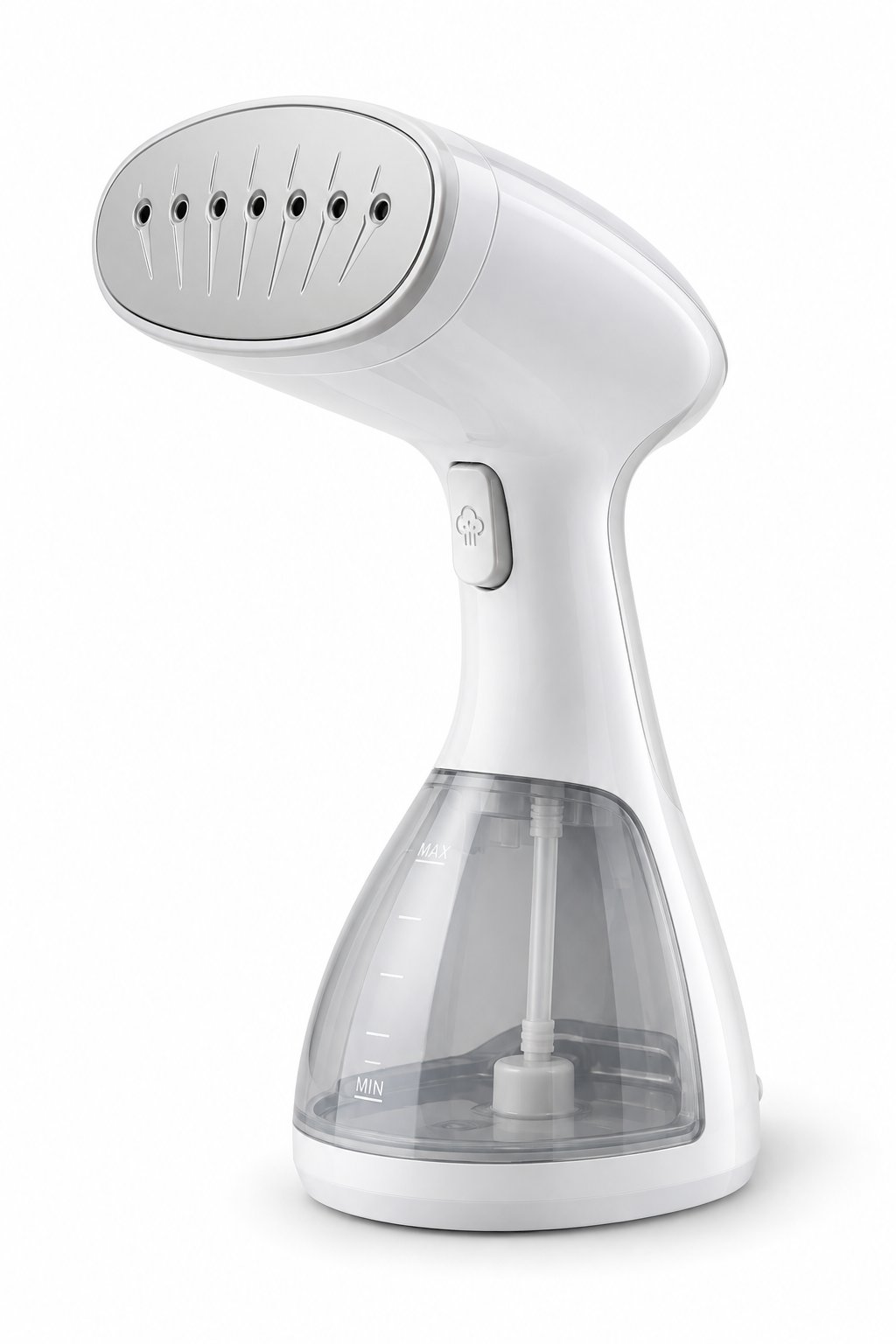
A factory quote for a handheld garment steamer moves with the specification you choose and the order volume you commit to. This article breaks down how tank capacity, power rating, heat-up speed, attachments, voltage certification, MOQ and packaging each shift the unit price, using the ZY-GS1300 as a concrete reference point for overseas B2B buyers running private-label programs.
Sourcing & Pricing Guide
If you are costing out a private-label handheld garment steamer, the number you need is not a list price — it is a factory quote built from the spec you choose and the volume you commit to. This article explains exactly which variables move that quote, using the ZY-GS1300 as a working reference.
What this article covers
Overseas buyers typically arrive at this question after browsing retail marketplaces and seeing handheld steamers at very different price points. That spread is not random. It reflects differences in tank volume, wattage, heat-up behaviour, accessories, voltage certification and order size — the same levers a factory uses to build your quotation.
Spec Variables That Shape the Quote
Water tank capacity
Tank volume is one of the first specification items a factory prices. A larger tank usually means a larger moulded part, more material and a different internal layout. The ZY-GS1300 uses a 250 ml transparent food-grade tank. Beyond the raw material, tank size affects the moulding tooling and the assembly time per unit, both of which feed into the unit price. OEM/ODM customization of tank capacity is available, so if your target market expects a longer continuous-steam session, that change is a specification decision you can raise at quotation stage.
Power rating
The ZY-GS1300 is rated at 1000 W. Power rating influences the heating element, internal wiring and the safety margins the product must hold under the destination market's electrical rules. A higher wattage generally requires a more robust element and wiring, which is reflected in the quote. It is also the parameter that most affects how quickly the unit reaches working temperature and how steadily it delivers continuous steam during use.
Heat-up speed
Heat-up time is a function of the element, the tank-to-heater path and the control logic. The ZY-GS1300 reaches working temperature in approximately 30 seconds. For a private-label program, heat-up speed is often a marketing specification as much as an engineering one — it is one of the details buyers reference when positioning a product against competitors on the shelf or in a listing. When it changes, the heating assembly and sometimes the control board change with it, and both carry cost.
Attachments and included accessories
The ZY-GS1300 ships with a brush attachment. Every additional attachment — fabric brushes, lint pads, travel pouches, measuring cups — adds a line item to the bill of materials and to the packing operation. For OEM/ODM programs, the accessory set is worth deciding early, because it affects both the unit cost and the retail packaging dimensions, which in turn affect freight.
Voltage and certification
The same handheld steamer can be built for different markets, and the electrical configuration is a real cost variable. The ZY-GS1300 is available in 220-240V/50Hz for EU markets and 120V/60Hz for the US market. CE and RoHS documents are available on request. If your program targets both regions, you are effectively sourcing two electrical variants, and the buyer should expect the quotation to reflect that. Confirm with your supplier which certification documents apply to the exact configuration and destination you are ordering.
Key takeaways
- Tank volume, wattage, heat-up speed and attachments are specification choices that each carry a distinct cost.
- Voltage certification (EU 220-240V vs US 120V) can turn one product into two SKUs with two cost structures.
- MOQ, packaging and Incoterms are order variables that move the landed number as much as the spec does.
- Ask for a quote against your exact configuration rather than comparing headline figures across suppliers.
Order Variables: MOQ, Packaging, Freight and Terms
MOQ and how it interacts with customization
The ZY-GS1300 has a minimum order quantity of 500 units. MOQ matters because it determines whether tooling, setup and material procurement are spread across enough units to make the per-unit price workable. If you are requesting OEM/ODM changes — a different tank capacity, a different finish, or your own branding — the MOQ and the customization scope are usually negotiated together. A buyer planning a first trial order should confirm whether the customization they want is available at the standard MOQ or requires a different arrangement.
Packaging
Packaging is easy to overlook at quotation stage and expensive to change later. Retail packaging affects unit cost (printing, inserts, box structure) and freight (carton dimensions and weight). If your private-label program requires branded retail boxes, that specification should be part of the initial quotation request, not an afterthought once the unit price is agreed.
Freight and Incoterms
Quotations are commonly offered on sea freight FOB or CIF terms. The difference matters: FOB leaves freight and insurance to the buyer from the port of loading, while CIF includes them to the destination port. Neither is inherently better — it depends on whether your business has its own freight forwarder and whether you prefer a single landed figure. State your preferred term when requesting a quote so the numbers you receive are comparable.
Lead time and payment terms
The ZY-GS1300 lead time is 30-45 days after sample approval. Payment is typically T/T with a 30% deposit. For planning purposes, the sample-approval milestone is the real clock-starter, so buyers running a seasonal launch should build sample turnaround into the schedule before the 30-45 day production window begins.
| Variable | ZY-GS1300 reference | How it affects the quote |
|---|---|---|
| Tank capacity | 250 ml, transparent food-grade | Material, moulding and assembly time; customizable via OEM/ODM |
| Power rating | 1000 W | Heating element and wiring specification |
| Heat-up speed | Approx. 30 seconds | Heating assembly and control logic |
| Attachments | Brush attachment included | Bill of materials and packing operation |
| Voltage / certification | 220-240V/50Hz (EU); 120V/60Hz (US); CE and RoHS available on request | May require two electrical variants and separate documentation |
| MOQ | 500 units | Determines how fixed costs are spread |
| Lead time | 30-45 days after sample approval | Affects working capital and launch timing |
| Freight / payment | Sea freight FOB or CIF; T/T 30% deposit | Determines landed cost structure and cash flow |
You can review the full published configuration of the handheld garment steamer before sending a specification request, so the quote you receive maps directly to the product you are evaluating.
Is a Garment Steamer Worth It? A Quick Retail-Range Check
The companion question — whether a handheld garment steamer is worth stocking — is really a question about retail positioning. Rather than relying on a single price figure, buyers can work through a short check:
- Does the specification support the price tier you want to sell in? Tank volume, wattage and heat-up time are the specifications shoppers compare most often. A 250 ml tank and 1000 W rating sit within a mainstream handheld configuration, which gives you a workable base for a mid-range private-label position.
- Can you serve more than one market with one program? Because the platform supports both EU and US voltage configurations, a single product concept can be adapted across regions — though you should confirm certification documents for each destination.
- Do the order terms match your first-run risk? With an MOQ of 500 units and a 30-45 day lead time after sample approval, the commitment is suited to a considered first order rather than a speculative bulk buy.
- Is there room for your brand? OEM/ODM customization of tank capacity, finish and branding means the product can carry your label rather than competing as a generic item.
If the answers line up with your retail range, the next step is not a generic price request — it is a specification request. Send the tank capacity, wattage, voltage, attachment set, packaging requirement and target quantity you have in mind, and ask for a quote on those terms.
FAQ
How much is a handheld garment steamer from a factory?
There is no single figure, because the quote depends on your specification and order volume. Tank capacity, power rating, heat-up speed, attachments, voltage configuration, certification documentation, MOQ, packaging, freight terms and payment terms all contribute. The practical approach is to request a quotation against your exact configuration.
Does the MOQ change if I customize the product?
The ZY-GS1300 has a standard MOQ of 500 units. OEM/ODM customization of tank capacity, finish and branding is available, and the applicable MOQ should be confirmed with the supplier for the specific customization you are requesting.
Can one order cover both EU and US markets?
The product is available in 220-240V/50Hz (EU) and 120V/60Hz (US) configurations, with CE and RoHS available on request. Because these are different electrical builds, buyers should confirm the certification and documentation that apply to each destination market.
What is the lead time?
Lead time is 30-45 days after sample approval. Sample turnaround time should be planned separately, as the production window begins once the sample is approved.
Ready to price your private-label program?
Share your target tank capacity, wattage, voltage, attachment set, packaging and quantity, and request a quotation built around your specification.
Request a quote for the ZY-GS1300