A buyer-facing breakdown of what really changes a private-label hair dryer factory quote — motor power tier, heat and speed settings, attachments, voltage certification for EU vs US, order volume and packaging — using the published ZY-HD1400 model as a reference point, plus a spec checklist to take into your quote request.
Most overseas buyers searching for hair dryer cost want one thing: a number they can plan a landed-cost sheet around. Factories cannot give an honest number before they know the specification, order quantity and destination market. What we can do is show you which choices move the factory quote and which ones barely register — so you spend your negotiating time where it counts.
What this article covers
- Why there is no single “hair dryer price”
- The specification choices that move unit cost
- What usually does not move the quote much
- Order volume, packaging and freight
- A buyer checklist before you request a quote
- FAQ
Why one price doesn't exist
Two 1800 W hair dryers can differ in quote level even when their motor wattage reads the same on paper. The variation comes from the parts that carry the CE or electrical safety file, the tooling needed for a private-label housing, the cable and plug assembly for the destination country, and the packaging format.
That is why the practical answer to “how much does a hair dryer cost?” is: it depends on the spec sheet, the order volume and the market. Ask a supplier for a number before they have those three, and you will either get a placeholder or a figure that changes once the real specification arrives.
What actually moves the factory quote
Motor power tier (1600 W vs 1800 W)
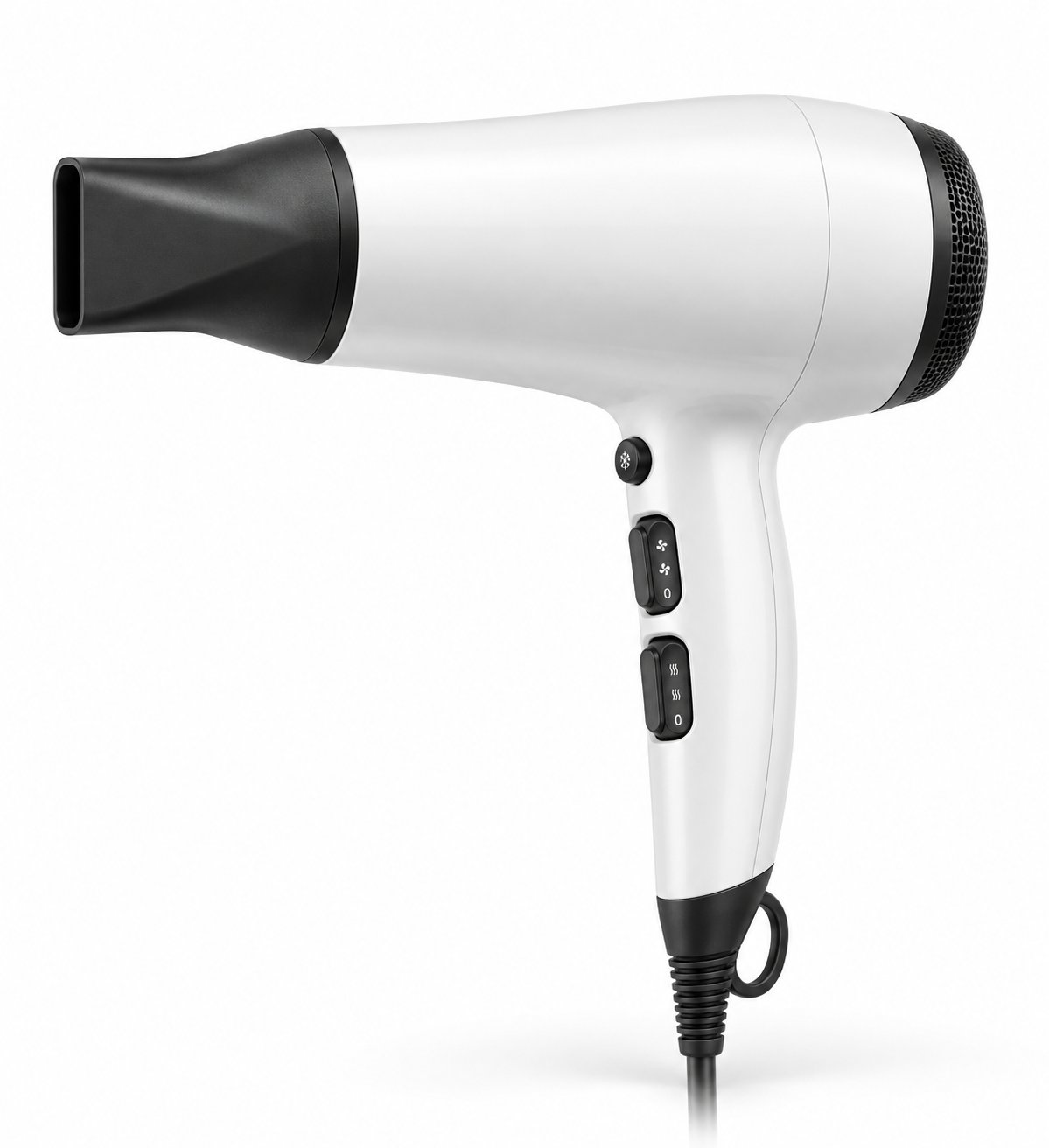
Power rating is the first lever. Manufacturers often group models around standard ratings rather than offering every wattage as a custom build. For example, the published ZY-HD1400 is built around an 1800 W motor, and 1600 W is the standard alternative in the same family. These are standard rating tiers, not a continuous dial — so if your market brief calls for 2000 W, expect that to be a development conversation rather than a simple option tick.
Higher-wattage builds can require a different motor, cord gauge and thermal protection set to satisfy the same safety testing. That combination is what raises cost — not the wattage number alone.
Heat levels, speed settings and the cool-shot function
A basic unit with two heat levels and two speeds uses simpler switching than a model with three heat levels, two speeds and a separate cool-shot button. Each added control means another switch position, more wiring and more assembly time. The difference per unit is usually modest, but at high order volumes it is worth deciding deliberately whether the extra setting is something your retail buyer will actually use or something you are paying for on every carton.
Attachments: concentrator, diffuser, both
An included concentrator nozzle is a common baseline. Adding a diffuser or a second nozzle changes tooling, BOM and packing layout. The attachment decision is also a retail-positioning decision: an accessory-rich box supports a higher shelf price, while a lean box keeps the unit cost lower. Neither is automatically better — match it to the channel.
Voltage, plug and certification for EU vs US
This is one of the biggest structural drivers. A unit built for 220–240 V / 50 Hz (EU) and a unit built for 120 V / 60 Hz (US) are not the same product with a different sticker. They need the matching heating element, motor configuration, cord set, plug type and, in most cases, separate testing files.
If you plan to sell in both regions from one supplier, do not assume a single SKU covers both markets. Raise it at the sample stage so the voltage and documentation scope are agreed before tooling or large orders begin.
Housing material and finish
The published ZY-HD1400 uses an ABS housing. Housing choice affects both tooling investment and unit cost, and OEM/ODM customization of power, finish and branding is available on that platform. If you are developing your own housing shape, budget for tooling separately from unit cost — they behave differently in a quote and in your cash flow.
Order volume
Almost every cost line above improves at higher volume: component purchasing, assembly setup, printing plates for retail packaging, and inspection time. The listed MOQ for ZY-HD1400 is 500 units. Ask what changes at your target annual volume rather than requesting a single quantity price, because factories quote differently for a one-off trial and a repeat program.
Packaging format
Plain carton, printed retail box, blister pack and master carton configuration each carry different tooling, printing and packing labor. A retail-ready printed box can add more to your landed cost than a small wattage change. Decide the packaging format before you ask for a quote, not after.
Quick reference: what moves the quote most
- Biggest impact: private-label tooling, retail packaging format, dual-market voltage/certification scope.
- Moderate impact: motor power tier, number of heat/speed settings, extra attachments.
- Smaller impact: finish variations on an existing housing, branding printing on a standard carton.
Magnitude is qualitative. Confirm exact figures in a written quotation tied to your specification.
What usually does not move the quote much
Buyers sometimes spend negotiating energy on the wrong items. On a standard platform, changing the color of an existing ABS housing or printing your logo on a standard carton rarely reshapes the quote. Likewise, adding a listed accessory to an existing attachment set is a smaller factor than moving to a different motor tier or opening a new housing tool.
That is useful in a negotiation: if you need cost down, changes in this second group will not get you far. The spec-level decisions — power tier, voltage market, packaging format and volume — are where the real movement is.
Order volume, certification and freight
Certification scope matters to your quote because testing and documentation sit alongside the unit. For ZY-HD1400, CE and RoHS are available upon request. If you need those documents for the EU market, say so at the quotation stage so they are included in the plan rather than treated as an afterthought. For the US market, confirm the applicable documentation for the 120 V / 60 Hz build before you commit to a launch date.
Freight is quoted separately from the ex-works unit price in most programs. ZY-HD1400 is normally shipped by sea on FOB or CIF terms, and payment terms are 30% deposit by T/T. Lead time runs 30–45 days after sample approval — so sample approval sits on your critical path, not after it.
Buyer checklist before you request a quote
Bring these to the table and you will get a usable quotation instead of a placeholder:
- Target market(s): EU, US, or both — with the voltage and plug type required.
- Power rating: 1600 W or 1800 W, or a different rating if your brief demands it (confirm feasibility).
- Controls: how many heat levels, how many speeds, cool-shot yes/no.
- Attachments: concentrator only, or diffuser too.
- Housing: use an existing housing, or private-label tooling.
- Packaging: plain carton or printed retail box; master carton requirements.
- Volume: trial order quantity and expected annual volume, if known.
- Documentation: confirm whether CE / RoHS are required for your program.
- Commercial terms: FOB or CIF, destination port, and payment terms.
- Timeline: when you need the sample approved, working back from your retail launch.
If you can answer most of these, ask for a quotation broken down by specification, not a single headline figure. A specification-linked quote lets you see exactly which choice is costing you money.
FAQ
Can you give me a price now if I already know I want an 1800 W dryer?
Wattage alone is not enough. Voltage market, controls, attachments, packaging format and quantity all affect the quote. Send those details with your inquiry and you will get a figure you can actually use.
Is a dual-voltage unit available for both Europe and North America?
Treat EU and US builds as separate specifications. The published ZY-HD1400 covers 220–240 V / 50 Hz (EU) and 120 V / 60 Hz (US) configurations. Confirm which markets you need and whether you want one specification or two before sampling.
What is the minimum order quantity?
For ZY-HD1400 the listed MOQ is 500 units. Ask how the quote changes at your expected annual volume.
Which certifications are available?
CE and RoHS are available upon request on ZY-HD1400. Confirm your market's requirements with your supplier so the right documents are included in the quotation.
How long does production take?
Lead time is 30–45 days after sample approval. Plan sample approval early, because it starts that clock.
Next step
Do not anchor on a single dollar figure before the specification is fixed. List your market, power tier, controls, attachments, packaging and volume, then request a quotation that maps each line to a specification. If ZY-HD1400 is close to what you need, review the full specification and customization options on the hair dryer product page and send your requirements — OEM/ODM customization of power, finish and branding is available, and a specification-linked quote will tell you far more than a generic price.