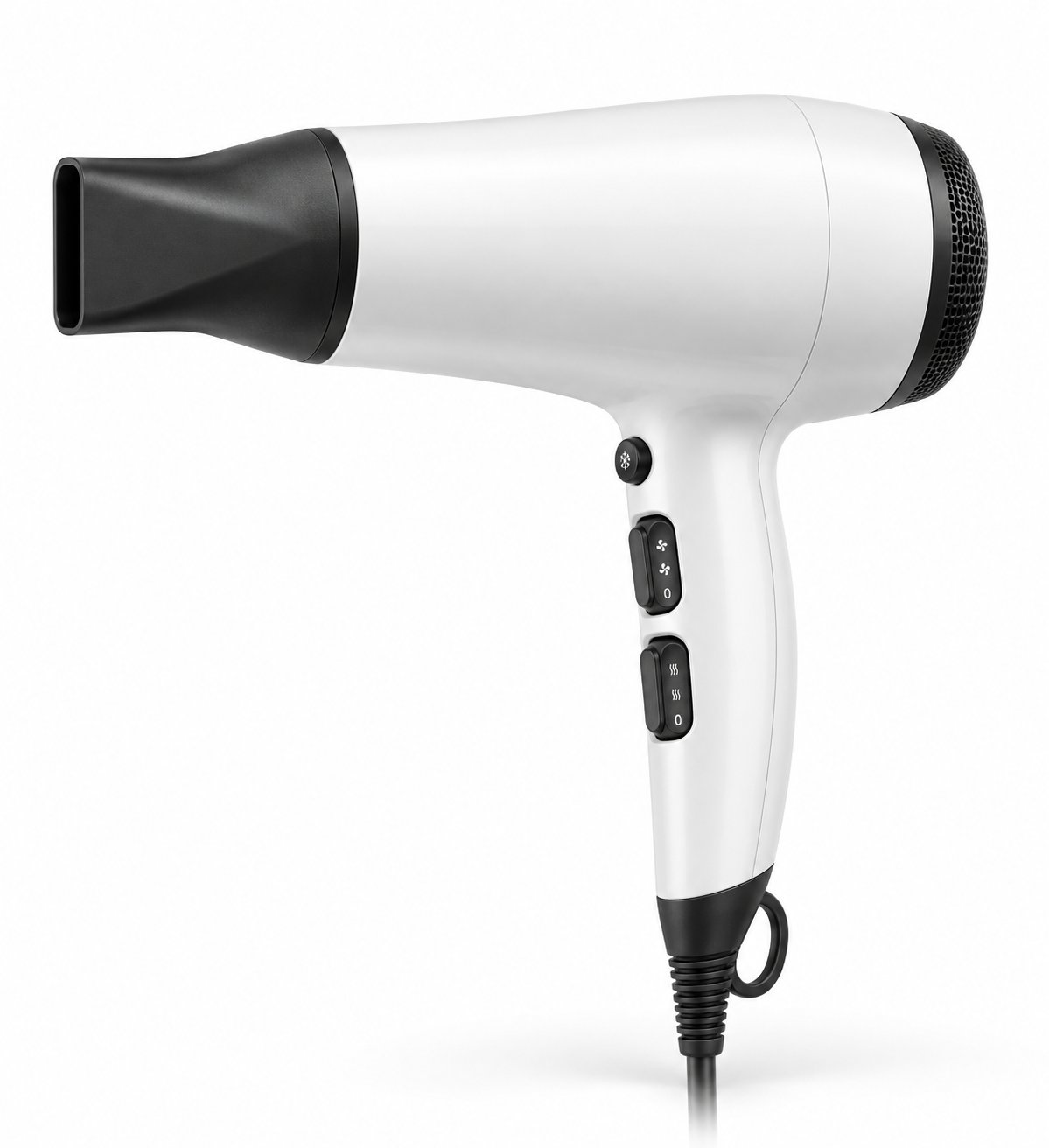
A diffuser spreads airflow over a wider area to reduce frizz and preserve curl definition, while a concentrator nozzle focuses air for smooth, directed styling. This article explains the functional difference, which end-user segments seek each attachment, and what private-label buyers should verify when specifying attachments—including fit, material, and packaging. It also clarifies that the published ZY-HD1400 ships with a concentrator nozzle; a diffuser is a customization topic to confirm with the manufacturer.
A diffuser is the attachment that turns a concentrated stream of hot air into a wide, gentle flow. It is used to dry or shape wavy, curly, and coily hair with less disturbance to the curl pattern than a standard nozzle. For private-label buyers building a hair dryer range, the diffuser is not a universal accessory: it serves a specific end-user segment, works differently from a concentrator nozzle, and has its own fit, material, and packaging implications. This article explains what a hair dryer diffuser is used for, how it compares with a concentrator nozzle, which customers look for each, and what to verify when specifying attachments for a retail line.
Key takeaways
- Function: A diffuser spreads airflow over a wider area, reducing direct force on the hair and helping preserve curl definition while cutting frizz.
- Difference from a concentrator: A concentrator nozzle narrows and directs airflow for precise, smooth styling; a diffuser does the opposite—it disperses the air.
- End-user segments: Curly, wavy, and coily hair users typically seek a diffuser; straight-hair users who blow-dry for smoothness typically rely on a concentrator nozzle.
- Buyer checklist: Confirm barrel diameter and attachment fit, material and heat resistance, packaging format, and whether the diffuser is included or sold separately.
- Current model note: The published ZY-HD1400 ships with a concentrator nozzle. A diffuser attachment is a customization topic to confirm with the manufacturer—do not assume it is included.
What a Hair Dryer Diffuser Is Used For
A hair dryer diffuser attachment disperses the dryer's airflow across a broad, often pronged surface instead of pushing it through a single narrow opening. The result is a softer, wider column of air that reaches more of the hair at once without blasting a concentrated stream against one section. In practice, this is used for three main purposes:
- Drying without disrupting curl pattern. Because the air is spread out, the hair moves less during drying. That helps wavy, curly, and coily hair keep its natural shape rather than being blown straight or frizzed.
- Reducing frizz. Frizz often comes from hair being disturbed while it dries. A gentler, wider airflow gives the cuticle less cause to lift and roughen.
- Adding volume at the roots. Many diffuser designs include prongs or fingers that can be used to lift hair near the scalp while drying, which is a common technique for adding volume in curly styles.
The attachment does not change the dryer's motor or heat output. It changes how that output is delivered. A diffuser on a dryer with adjustable heat and speed settings is typically used on lower heat and lower speed to avoid over-drying or disturbing the curl. This is why buyers specifying a diffuser should also consider whether the host dryer offers enough control—multiple heat levels and at least two speed settings—to make the attachment useful in real use.
Diffuser vs Concentrator Nozzle: What Changes for the User
The two attachments solve opposite problems. A concentrator nozzle narrows the airflow into a focused, directional stream. It is the attachment for precise work: directing air along a section of hair to smooth it, controlling where the air lands around a round brush, or blowing out a specific area without disturbing the rest. A diffuser does the reverse—it widens and softens the airflow so it acts on a broader area more gently.
For a retail buyer, the comparison matters because the two attachments appeal to different styling routines, and some users want both. A dryer sold only with a concentrator nozzle serves customers who blow-dry for smooth, straight, or sleek results. A dryer sold with a diffuser—or with both—serves customers who wear their hair wavy, curly, or coily and want to dry it without losing definition. The table below summarizes the practical differences.
| Consideration | Concentrator Nozzle | Diffuser Attachment |
|---|---|---|
| Airflow shape | Narrow, focused, directional | Wide, dispersed, gentle |
| Primary styling goal | Smooth, sleek, precise blow-dry | Preserve curl, reduce frizz, add volume |
| Typical hair types | Straight, wavy when smoothing | Wavy, curly, coily |
| Common techniques | Blow-dry with brush, direct airflow | Scrunch, lift at roots, low-heat drying |
| Effect on curl pattern | Can stretch or straighten | Helps maintain definition |
Neither attachment is inherently better. They are tools matched to different routines, and a range that offers only one may leave a segment of buyers looking elsewhere. The decision for a private-label line is therefore about target customer, not about which attachment is superior.
Which End-User Segments Need Each Attachment
Buyers planning a hair dryer range can think about attachments in terms of the customer the product is meant to serve.
Customers who primarily need a concentrator nozzle
- Users who blow-dry for smooth, straight, or sleek finishes and rely on directional airflow.
- Users who style with a round brush and need air aimed precisely at the brush and section.
- Users who want to control airflow around the face, bangs, or a specific parting.
Customers who seek a diffuser
- Users with wavy, curly, or coily hair who dry their hair while keeping its natural pattern.
- Users following curly-hair routines that emphasize low heat, low speed, and minimal disturbance.
- Users who want root volume without directing a concentrated stream at the scalp.
Some buyers will want both attachments in one box, particularly if the product is positioned as a versatile styling dryer rather than a single-purpose tool. Others will target one segment and keep the kit simple. Both approaches are valid; what matters is that the attachment set matches the customer the product is aimed at.
What Buyers Should Check When Specifying Attachments
Attachments are easy to treat as an afterthought, but they affect fit, perceived quality, and packaging. The following points are worth confirming with the manufacturer before finalizing a private-label order.
Fit and compatibility
- Barrel diameter and connection type. A diffuser must seat securely on the dryer's outlet. Confirm the exact barrel diameter and whether the attachment uses a push-on, twist-lock, or magnetic connection. A loose fit is a common source of returns.
- Weight and balance. A diffuser is often larger than a concentrator nozzle. Check how the added size affects the balance of the dryer in hand, especially during the longer drying times typical of curly-hair routines.
- Whether the attachment is included or sold separately. This should be stated clearly in the product listing. Do not assume a diffuser is part of the box unless the manufacturer confirms it.
Material and heat resistance
- Material compatibility with heat. Attachments sit in the hot-air path and should be made from materials suited to that environment. Ask the manufacturer what material is used and how it is specified for the dryer's heat range.
- Surface finish and cleaning. Prongs and openings can collect product buildup. Confirm whether the attachment is designed to be wiped or rinsed, and whether the material tolerates that.
- Color and finish consistency. If the diffuser is part of a branded set, its finish should match the concentrator nozzle and the dryer body for a coherent retail presentation.
Packaging and presentation
- How the attachment is packed. Confirm whether the diffuser ships in the same carton as the dryer, in a separate compartment, or as a standalone accessory. This affects carton dimensions, protection, and retail shelf logic.
- Instruction and labeling. If the diffuser is included, decide whether the manual and retail packaging should show it and explain its use. Clear labeling reduces customer confusion about which attachment does what.
- MOQ and lead time for customized attachments. A customized attachment may have its own tooling and order requirements. Confirm MOQ and lead time separately from the dryer itself.
A Note on the ZY-HD1400 and Diffuser Customization
Current model status: The published ZY-HD1400 ships with a concentrator nozzle. A diffuser attachment is a customization topic, not a standard inclusion. Buyers interested in a diffuser for this model should confirm availability, fit, tooling, MOQ, and lead time directly with the manufacturer before building it into a product plan.
For reference, the ZY-HD1400 is specified with an 1800 W motor, 3 heat levels, 2 speeds, and a cool-shot function. It is available in 220–240 V / 50 Hz (EU) and 120 V / 60 Hz (US) versions, with an MOQ of 500 units and a lead time of 30–45 days after sample approval. OEM/ODM customization covers power, finish, and branding. The concentrator nozzle is the attachment included as standard; a diffuser would need to be discussed as part of the customization scope.
This distinction matters for buyers because attachments are often where private-label differentiation happens. A dryer that ships only with a concentrator nozzle addresses blow-dry and smoothing routines. Adding a diffuser would extend the same platform to curly and wavy hair users, but that is a change to the product configuration and should be planned and quoted accordingly.
Frequently Asked Questions
A diffuser is an attachment that spreads the dryer's airflow over a wider area instead of concentrating it. It is used to dry wavy, curly, or coily hair more gently, helping to preserve curl definition and reduce frizz. It is distinct from a concentrator nozzle, which narrows the airflow for precise, smooth styling.
It is used mainly for drying hair with less disruption to the curl pattern, reducing frizz, and adding volume at the roots. Users typically pair it with lower heat and lower speed settings. It is not intended for creating a sleek, straight blow-dry—that is the role of a concentrator nozzle.
No. The published ZY-HD1400 ships with a concentrator nozzle as standard. A diffuser attachment is a customization topic. Buyers should confirm availability, fit, and terms with the manufacturer before assuming it can be included.
It is possible as a customization, but it depends on the manufacturer's tooling, fit, and packaging capabilities for the specific model. Buyers should raise this during the specification stage so that MOQ, lead time, and packaging can be quoted accurately.
Confirm the barrel diameter and connection type (push-on, twist-lock, or magnetic), how the attachment seats on the dryer, and how the added size affects balance in hand. A loose or awkward fit is a frequent reason for customer returns, so it is worth testing a sample before committing to a production run.
Planning Attachments for a Private-Label Range
The attachment decision follows the end-user segment. A range aimed at blow-dry and smoothing routines is well served by a concentrator nozzle. A range that wants to reach wavy, curly, and coily hair users should plan for a diffuser as part of the configuration—and treat it as a customization item with its own fit, material, packaging, and commercial terms. Buyers reviewing the ZY-HD1400 should start from the published configuration and confirm any diffuser addition directly with the manufacturer before it goes into a product plan.
If you are specifying attachments for an upcoming range, share your target market, hair-type focus, and packaging requirements. The manufacturer can confirm what is feasible for the model you are considering and provide the relevant terms.