Food processor cost questions usually get retail price lists, which do not help an OEM buyer. This article explains the specification choices that move a factory quote — motor power class, bowl capacity and material, attachment set, speed and pulse control, food-contact materials, certification and packaging for the target market — and how to compare two quotes on equal specification footing. It uses the site's 800 W / 2 L model ZY-FP1000 as a concrete baseline configuration and shows where hidden costs appear: samples, custom tooling and per-market certification.
OEM Cost Drivers
Search for food processor cost and most results hand you a retail price list. That is not what a buyer placing 500 units needs. What a buyer needs to know is which specification decisions inside a quotation actually move the number, and how to tell whether two quotes are describing the same machine.
The honest answer to "what does a food processor cost" from a factory's side is that pricing follows specification and order terms. This article sets out the choices that drive an OEM quote, using 800 W and 2 L as a working example, and flags the line items buyers often miss when comparing suppliers.
Key takeaways
- Motor power class, bowl capacity and material, attachment count and control type are the four biggest cost variables in a food processor quote.
- Two quotations can only be compared once power, bowl, attachments, voltage, certification scope and packaging are fixed at the same level.
- Samples, custom tooling and per-market certification are separate, sometimes staged costs that rarely appear in a headline unit figure.
- A model such as the 800 W 2 L food processor ZY-FP1000 gives buyers a concrete baseline to compare other offers against.
In this article
- What buyers mean by "food processor cost"
- The specification choices that move an OEM quote
- Baseline configuration: 800 W and 2 L as a reference point
- How to compare two quotes on equal specification footing
- Where hidden costs appear
- What the food processor is actually good for
- Certification and packaging by target market
- Frequently asked questions
What buyers mean by "food processor cost"
The question "how much does food processor cost" gets asked with two very different meanings. One is consumer-facing: what will this appliance sell for on a shelf? The other is what an OEM or private-label buyer really has in mind: what will a factory charge me to build the unit I have specified, at the quantity I am ordering, delivered on the terms I need?
For a buyer, cost is the sum of a specification, a quantity and a set of commercial terms. Change the motor from one power class to another, add a disc, switch the finish, or ask for certification in a new market, and the quotation moves. That is why a single figure without a specification behind it tells you almost nothing useful.
It is also why a price list is the wrong tool for sourcing decisions. What you want from a supplier is a cost structure you can line up against their competitors — same motor, same bowl, same attachments, same certification scope — so the comparison is real.
The specification choices that move an OEM quote
In countertop food processors, a handful of specification decisions account for most of the variation between one quote and another. Buyers who understand them can read a quotation the way a project manager reads a bill of materials.
Motor power class
The motor is the single largest functional cost item. It sets the work the appliance can handle — chopping, slicing, shredding, kneading — and how long it can run. A domestic-oriented motor and a heavier motor for more demanding use sit in different power classes, with different winding, copper content and cooling. When two quotes differ mainly in price, the first question is whether the motors are in the same class.
Work bowl capacity and material
Bowl capacity drives how much material the processor can take in one batch. Bowl material matters too: a food-grade BPA-free plastic bowl with clear capacity markings is a different build from a plain bowl of unknown grade. Clear markings are a minor cost item but a genuine usability feature, because they let the end user measure as they work.
Attachment set and disc count
Each accessory adds tooling, material and packaging weight. A basic unit may ship with a chopping blade alone; a fuller set adds slicing and shredding discs, and sometimes a dough blade or citrus attachment. Every extra disc is an extra line in the injection-molding or stamping plan. When buyers compare offers, the attachment list is one of the most common places where specifications quietly diverge.
Speed and pulse control
Two speeds plus pulse is a common mid-range control set. More speeds, electronic controls or a digital interface add components and change the tooling on the housing. Conversely, a single-speed unit trims cost but limits what recipes the end user can attempt. Control type is a genuine specification choice, not a cosmetic one.
Food-contact materials
Stainless steel blades and food-contact plastics that meet BPA-free requirements are baseline expectations in Europe and North America. Buyers should expect the supplier to confirm the grade of each food-contact part, and to hold that grade stable across production runs. Material substitution is one of the few places where an apparently cheaper quote becomes expensive later, in returns or compliance problems.
Voltage and plug configuration
Voltage is a hard specification, not a preference. A unit built for 220–240 V/50 Hz for the EU market is not the same as one built for 120 V/60 Hz for the US. Both variants can be produced, but the electrical build, plug and labeling differ. Making sure a quote states which variant it covers prevents a costly surprise at the sample stage.
Packaging and certification
Retail packaging — printed carton, inner protection, manual language, shipping-mark requirements — is a visible cost line for any private-label order. Certification scope for the target market is another. Both are discussed in more detail below, because both are where a quote can look competitive until the buyer adds what is actually required.
Baseline configuration: 800 W and 2 L as a reference point
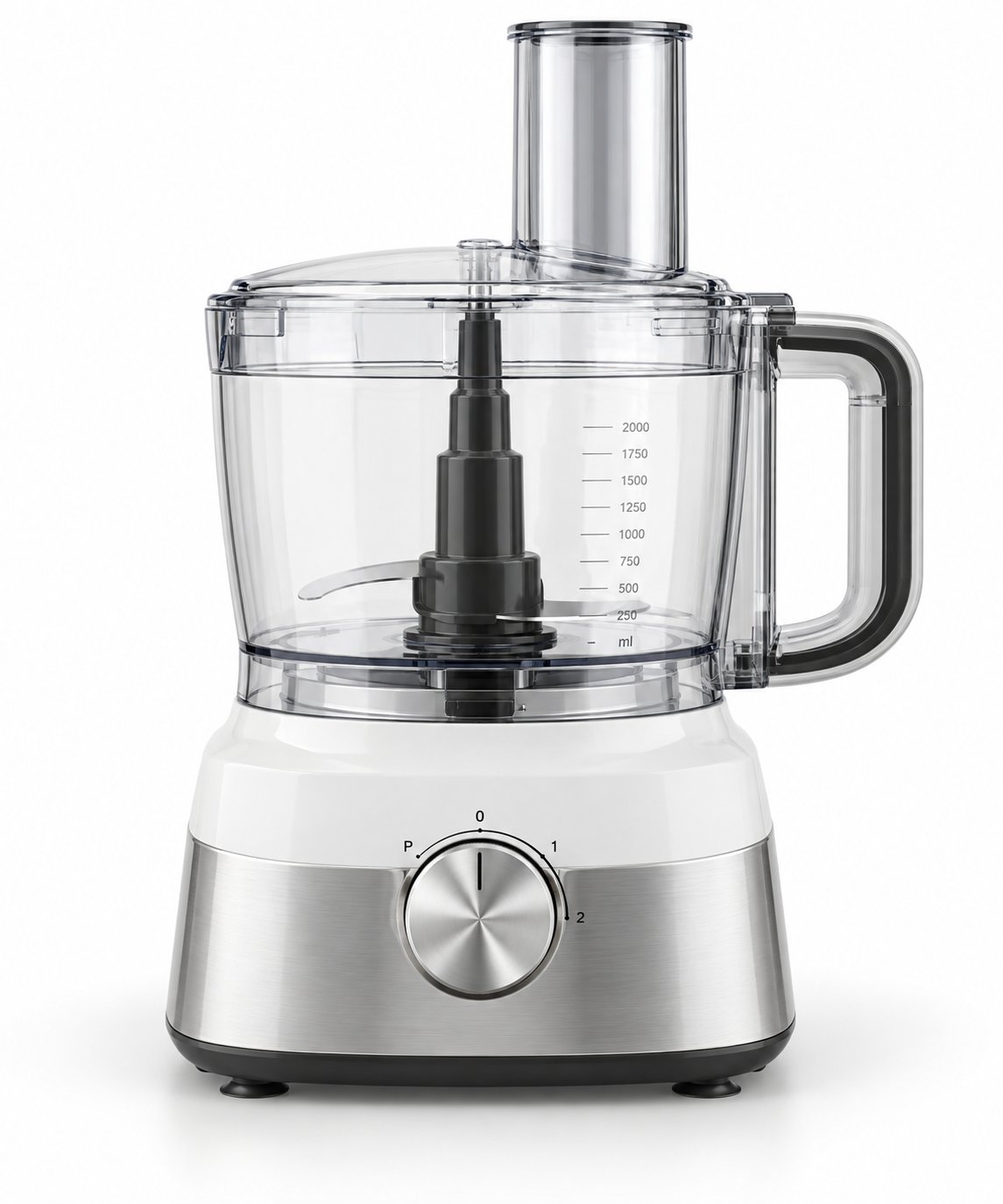
A baseline configuration helps make the discussion concrete. The site's 800 W 2 L food processor is a useful starting point because it sits in the middle of the domestic and light-commercial range on power, while offering a full accessory set.
Model ZY-FP1000
- 800 W motor
- 2 L work bowl with clear capacity markings, food-grade BPA-free plastic
- Stainless steel blades
- Attachments: chopping blade, slicing disc, shredding disc
- 2 speeds plus pulse
- Feed tube with pusher
- Bowl and removable parts dishwasher safe
- Voltage: 220–240 V/50 Hz (EU), 120 V/60 Hz (US)
- Dimensions: 250 x 250 x 400 mm; net weight 3.8 kg
- MOQ 500 units; lead time 30–45 days after sample approval
- CE/RoHS/LFGB available upon request
Buyers can use this specification as a measuring stick. If another supplier's quote is lower, the productive question is which of these lines is different: a smaller bowl, fewer discs, a lighter motor, a different control set, or a different certification scope. That is a more useful conversation than a straight price comparison.
How to compare two quotes on equal specification footing
The only fair comparison is one where both quotations describe the same machine. Before reading the numbers, put both quotes through the same checklist.
| Specification | Why it changes the quote | What to confirm |
|---|---|---|
| Motor power | Largest functional cost item; defines work capacity | Rated watts and duty class, stated the same way in both quotes |
| Bowl capacity and material | Drives batch size, material grade and tooling | Litres, plastic grade, presence of capacity markings |
| Attachment set | Each disc adds tooling and material | Exact list of blades and discs, and whether spares are included |
| Speed and pulse control | Changes electronics and housing tooling | Number of speeds, pulse present or not, control type |
| Food-contact materials | Grade stability and compliance | Blade steel and food-contact plastics, BPA-free confirmation |
| Voltage and plug | Electrical build and market labeling differ | Which market variant the quote covers |
| Certification scope | Testing and documentation cost per market | Which certificates, for which market, included or quoted separately |
| Packaging | Retail carton, manual, shipping marks | Packaging specification and language versions |
| Order quantity and terms | Affects setup amortization and per-unit cost | MOQ, lead time, payment and shipping terms |
Used properly, this table turns a confusing pair of quotations into a short list of genuine differences. If a supplier cannot state where their unit differs, that in itself is information.
Quantity and terms belong in the same comparison. A quote for 500 units and a quote for several thousand units are not the same offer, and a factory will normally reflect that in the price. Payment terms such as T/T with a 30% deposit or an L/C, and shipping terms such as FOB or CIF, change the commercial picture without changing the product at all. Keep them visible in the comparison rather than folding them into a single number.
Where hidden costs appear
Headline unit figures rarely tell the whole story. Three categories of cost tend to sit outside the base quote, and buyers should ask about each one explicitly.
Samples
Sample development usually happens before production and may be quoted separately. A sample that matches the intended production specification is a genuine investment, because it is the buyer's chance to verify motor behavior, bowl fit, disc performance and finish before committing to a full run. A sample that is hand-built and does not correspond to the production line is far less useful. Clarify what the sample represents and whether its cost is credited against the production order.
Tooling for custom parts
Any non-standard housing, bowl, disc or packaging component may require new tooling. Tooling is a one-time cost, sometimes amortized across the order and sometimes charged upfront. For private-label work this can include logo molds or custom trim. Buyers should ask which parts are standard and which require paid tooling, and how that tooling is handled if the project is reordered.
Certification per market
Certification scope is market-specific. A unit intended for the EU and a unit intended for the US do not carry the same documentation needs. CE, RoHS and LFGB are examples of market-related compliance available upon request for the model described above. Where certification is quoted separately, the buyer should confirm which certificate, for which market, at which testing stage, and who holds the documentation after the order ships.
What the food processor is actually good for
Buyers evaluating a quote often ask a related question: what is a food processor good for, and does the specification cover those uses? The short answer is that the combination of motor power, bowl capacity and attachment set determines what the appliance can do comfortably.
- Chopping and mincing: the chopping blade handles vegetables, nuts and similar ingredients.
- Slicing and shredding: the slicing and shredding discs handle cheese, carrots, cabbage and comparable items.
- Batch work: the 2 L bowl supports family-scale or light commercial portions rather than industrial volumes.
- Short-run processing: 2 speeds plus pulse suits recipes that need controlled bursts rather than long continuous running.
That is the practical connection between capability and price. A buyer who needs heavier continuous work is looking at a different power class and a different quote; a buyer who needs light food preparation is often over-specifying if they pay for capacity and run-time they will never use.
Certification and packaging by target market
Europe and North America have different expectations on documentation and packaging, and both should be settled before a quote is finalized.
- European market: CE and RoHS are commonly requested, with LFGB relevant to food-contact materials. Packaging should carry the language versions and shipping marks your channel requires.
- North American market: the 120 V/60 Hz variant is standard for the US, with plug type and labeling set accordingly. Packaging language and carton markings differ from the EU version.
A supplier used to working with European and North American buyers will normally treat certification and packaging as part of the quotation discussion rather than an afterthought. Buyers should treat them the same way.
Frequently asked questions
Can you give a single price for a food processor?
No useful single figure exists without a specification. Once motor power, bowl capacity, attachment set, control type, voltage, certification scope, packaging and order quantity are fixed, the factory can quote precisely. Before that, any number would be an estimate for a machine that may not be the one you want.
Is a higher-wattage food processor always more expensive to source?
Motor power class is one of the main cost drivers, so yes, power generally pulls the quote up. But power is not the only variable. A moderate-power unit with a full disc set and retail packaging can quote differently from a higher-power unit with minimal accessories. Compare the whole specification, not one number.
Does the MOQ affect the quoted cost?
Yes. The model described here has an MOQ of 500 units, and larger orders allow setup and tooling costs to be spread further. Buyers planning a full container naturally see a different structure from buyers testing a market with a single pallet.
What terms and lead time should a buyer expect?
For this model, lead time is 30–45 days after sample approval. Payment terms can be arranged as T/T 30% deposit or L/C, and shipping can be quoted FOB or CIF. These terms belong in the quotation discussion together with the product specification.
Can the unit be customized for our brand?
Yes, as an OEM/ODM arrangement. The scope of customization — logo, housing color, packaging, disc selection — determines whether new tooling is needed and how the quote is structured. Buyers should describe the intended branding and market clearly at the requirement-review stage.
The next step: request a quotation against your specification
The most reliable way to answer the cost question is to send your specification and let the factory respond against it. Include the target market, voltage variant, required certification scope, packaging expectations, branding requirements and estimated order quantity. With those details, the quotation conversation moves quickly from general ranges to a real number.
As an OEM/ODM manufacturer serving European and North American buyers, Guangdong Zhiyue Electric supports the full path from requirement review and sample development through production, QC and export delivery. If you are working from the 800 W 2 L configuration described above, or a variation of it, request a quotation and the team will respond against your specific specification and order terms.