There is no single global answer to what a kettle costs to boil, because the result depends on the local electricity tariff, the kettle wattage, the fill volume, the starting water temperature, and the boil time. This article gives B2B buyers a transparent formula instead of fake precision, shows how wattage and safety features affect both running cost and product positioning, and walks through one clearly labeled arithmetic example using a 2.2 kW EU model and a symbolic tariff T. It also explains what auto shut-off and boil-dry protection mean for buyer confidence, and why a 1.7 L stainless steel electric kettle with a 360-degree cordless base is a practical reference point for European and North American ranges.
Running cost and energy evaluation
Buyers who ask how much a kettle costs to boil usually want one of two things: a defensible way to compare models on energy use, or a number they can put into a specification or a retail listing. The honest answer is that no single figure travels across markets, because the same kettle can cost very different amounts to run depending on the local electricity tariff, how much water is boiled each time, and how the kettle is used. What does travel is a formula.
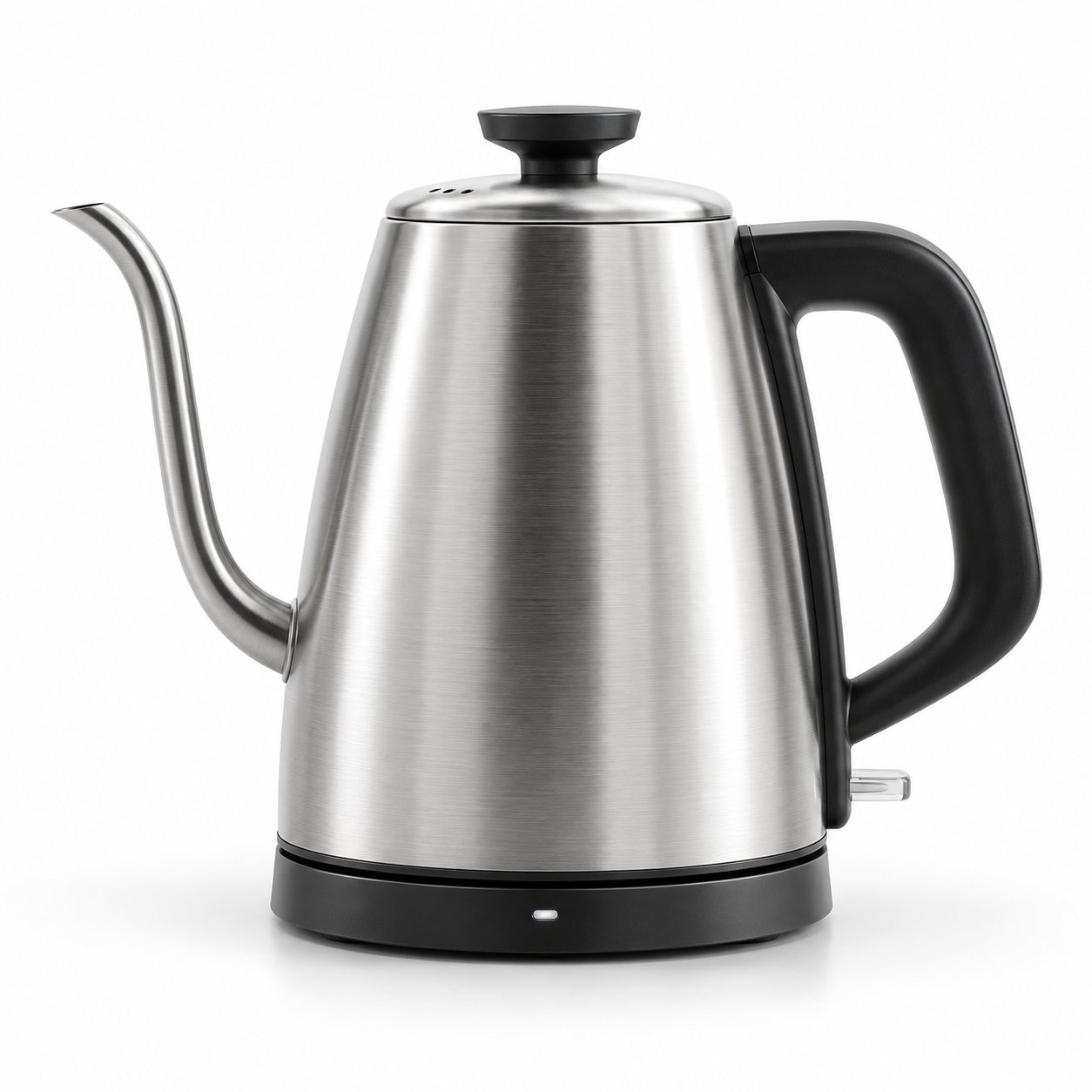
This article sets out that formula, explains which product specifications actually change the result, and shows how to read wattage as a comparable specification rather than a marketing number. It uses one reference product throughout: this 1.7 L stainless steel kettle, an OEM/ODM model in the range of Guangdong Zhiyue Electric, a manufacturer serving European and North American buyers.
Key takeaways
- Cost per boil = (kettle wattage in kW x boil time in hours) x local electricity tariff. Tariffs differ by market, so the formula, not a fixed number, is the useful output.
- Wattage changes how fast energy is delivered, not how much energy a given volume of water needs. Higher wattage shortens the boil time, which changes the tariff multiplier.
- The variables a buyer controls are fill level, starting water temperature, and how often the kettle is used. The variables a supplier controls are wattage class and safety cut-offs.
- Auto shut-off and boil-dry protection matter for running cost because they stop energy use at the right moment, and for safety because they limit dry heating.
On this page
- The cost-per-boil formula
- What changes the result
- A worked arithmetic illustration
- Why wattage is a comparison spec
- Safety features and running cost
- Reference specifications
- Questions buyers ask
The cost-per-boil formula
Electrical energy is billed by the kilowatt-hour. A kettle converts that energy into heat with a concealed heating element, and the cost of one boil is simply the energy used multiplied by the local tariff. The formula below is the framework to apply to any candidate model in any market:
Each term behaves differently. Wattage is a published product specification, so it is known before purchase. Boil time depends on the volume of water and its starting temperature, and it is the term that varies most between households and between commercial settings such as staff kitchens, hotel rooms, or catering back-of-house. The tariff is set by the market and changes over time, which is why any article claiming a fixed price per boil should be treated with caution.
The formula also works in reverse. If a buyer has a target running cost per use and a known local tariff, the wattage and volume combination that keeps the kettle within that target becomes a specification requirement rather than a preference.
What changes the result
Five factors move the number, and it helps to separate the ones a buyer specifies from the ones an end user controls.
| Factor | Who controls it | Effect on cost per boil |
|---|---|---|
| Fill level, for example 1.5 L versus a full 1.7 L tank | End user | More water needs more energy; boiling less than a full tank lowers the cost of that boil |
| Wattage class, for example 2200 W EU versus 1500 W US | Buyer, through the specification | Higher wattage delivers energy faster and reduces boil time, so the time term in the formula falls |
| Starting water temperature | End user and installation | Cold tap water needs more energy than pre-warmed or previously boiled water |
| Boil time | Product and user together | Directly multiplies the tariff; a shorter boil time reduces cost |
| Local electricity tariff | Market | Scales the whole result up or down and is the main reason no single figure is published here |
A buyer cannot change the tariff or the laws of thermodynamics, but they can specify a wattage class, a capacity, and safety cut-offs that make the energy use predictable.
A worked arithmetic illustration
The following is an arithmetic illustration, not a quotation and not a market price. It uses the EU wattage of the reference model and a symbolic tariff T, so the structure of the calculation is visible without hiding it behind a currency amount.
Convert the wattage to kilowatts: 2200 W = 2.2 kW. For a full 1.7 L boil, if the boil time is b hours, then:
Suppose a buyer wants to test a target of half a full tank, that is about 0.85 L, with the same wattage. Because the volume is roughly halved, the energy required is roughly halved as well, so the arithmetic illustration becomes about 2.2 x 0.5b x T, assuming the same starting water temperature and the same boil endpoint. This is the kind of scenario a specification team can run internally once it replaces T with the current tariff in its own market.
Boundary conditions: the illustration assumes a typical kettle heating efficiency, an identical starting water temperature, and a defined boil endpoint. Changing any of these changes the result. No currency amount, market electricity price, or measured boil time is stated, because those must be supplied by the buyer from their own market data.
Why wattage is a comparison spec
Wattage appears on the rating label and, in the case of the reference model, in two market variants: 2200 W for EU 220–240 V/50 Hz and 1500 W for US 120 V/60 Hz. Those two numbers are not competing claims about efficiency. They reflect the voltage and current available in each market, and each is the appropriate class for its region.
Within the same market, comparing wattage tells a buyer how quickly a given volume can be brought to the boil. A higher wattage class shortens the time term, which reduces the tariff multiplier in the formula. It does not make the kettle more efficient at converting electricity into heat; the concealed heating element transfers energy directly to the water in both cases.
For procurement teams, the practical implication is that wattage should be listed alongside capacity, voltage, and frequency on any comparison sheet. A 1.7 L electric kettle at 1500 W and one at 2200 W are different products for different circuits, and the running-cost math should be run separately for each.
Safety features and running cost
Auto shut-off and boil-dry protection are usually presented as safety features, and they are. They also have a direct running-cost dimension.
- Auto shut-off ends the heating cycle when the boil is reached. Without it, a kettle left unattended continues to draw power, and the time term in the formula grows until someone intervenes.
- Boil-dry protection cuts power when the element is not covered by water. This prevents a dry-heating cycle that consumes energy without producing a usable boil, and it protects the heating element from damage.
For a B2B buyer, both features also support after-sales performance. A product that switches off reliably is easier to defend in a warranty discussion than one that relies on the user to intervene, and the absence of boil-dry protection is a common reason for returns in markets where kettles are used in staff kitchens and hotel rooms without supervision.
Reference specifications
The model discussed here is a 1.7 L stainless steel electric kettle with a 360-degree cordless base, produced by Guangdong Zhiyue Electric. The table below lists the specifications that matter most when running the cost formula and when matching a kettle to a market.
| Specification | Detail |
|---|---|
| Capacity | 1.7 L; 1.5 L and 1.7 L are standard, other sizes on request |
| Power | 2200 W (EU) / 1500 W (US) |
| Voltage and frequency | 220–240 V/50 Hz (EU) and 120 V/60 Hz (US) |
| Heating element | Concealed heating element |
| Safety | Auto shut-off and boil-dry protection |
| Base | 360-degree cordless base with LED power indicator |
| Body | Brushed stainless steel, wide opening with one-touch lid |
| Compliance documentation | CE/RoHS/LFGB available upon request |
| Order terms | MOQ 500 units; lead time 30–45 days after sample approval |
As an OEM/ODM manufacturer, Guangdong Zhiyue Electric runs quality control through production and final inspection, and works with European and North American buyers on market-specific variants such as the EU and US wattage and voltage combinations listed above.
Questions buyers ask
Can you tell us the exact cost to boil one kettle of water?
No, and no supplier should. The exact cost depends on the tariff in your market, the fill level, the starting water temperature, and the boil time. What we can confirm is the wattage, which is the product-side input to the formula.
Does a higher wattage kettle cost more to run per boil?
Not automatically. Higher wattage delivers energy faster, so the boil time term is shorter. The energy needed to heat a given volume of water does not change with wattage; what changes is how quickly it is delivered.
Why do EU and US versions have different wattage?
The variants match the supply in each market: 2200 W at 220–240 V/50 Hz for the EU, and 1500 W at 120 V/60 Hz for the US. Both are appropriate classes for their respective circuits, and each should be evaluated with its own local tariff.
How does capacity affect running cost?
Boiling a full 1.7 L tank uses more energy than boiling a smaller volume. The 1.5 L and 1.7 L standard sizes let buyers match capacity to typical usage, and other sizes are available on request.
Are certifications available for the EU and North American markets?
CE, RoHS, and LFGB documentation is available upon request. Buyers should confirm which documents their market and retail channel require before finalizing the order specification.
If you are evaluating a 1.7 L electric kettle for a European or North American range, the most useful next step is to run the formula above with your own tariff and your expected fill levels, then compare that result against the wattage and capacity options on the specification sheet. Send us your target market, voltage, and annual volume, and we can confirm which variant fits your range and what documentation your order requires.