A technical explanation for importers and private-label buyers: how low-speed masticating extraction differs from high-speed centrifugal spinning, why the industry cites lower heat and oxidation, and which specifications actually matter when comparing slow juicers — using the ZY-SJ100 as a worked spec example.
Technical Explanation
A slow juicer is a kitchen appliance that extracts juice by crushing and pressing produce at low rotational speed instead of shredding it against a high-speed spinning basket. That single mechanical difference explains most of the other differences buyers encounter — pulp texture, noise, how leafy greens behave, and why these machines are usually built with a narrower feature set but a wider range of food-grade materials.
This article covers how low-speed masticating extraction works, how it differs from centrifugal extraction, and which published specifications are worth comparing when you are evaluating models for a private-label or retail program. The ZY-SJ100 masticating slow juicer is used as a worked example of how those specifications appear on a real product sheet.
Key takeaways
- Slow juicers crush and press; centrifugal juicers shred and spin.
- The industry rationale for low-speed extraction centres on reduced heat build-up and oxidation during operation.
- Slow juicers are commonly positioned for leafy greens, wheatgrass and similar low-yield produce.
- Specs that matter for buyers: RPM, motor power, chute width, auger material, cup capacities, noise, voltage and certification scope.
- Yield percentages and nutrient-retention figures must come from your own sample testing, not from a specification sheet.
Slow Juicer vs Centrifugal Juicer: Two Different Mechanisms
The two mainstream juicer architectures differ in how they apply force to the produce.
Centrifugal (high-speed spinning)
A centrifugal juicer uses a rapidly spinning flat or conical basket fitted with a fine shredding disc. Produce is pushed onto the disc, shredded, and the resulting pulp is flung outward against the basket wall by centrifugal force. Juice passes through the mesh; pulp is retained and later ejected or scraped out.
The extraction happens in a very short time, and the mechanism is inherently aerobic — the shredding action and the fast air movement inside the basket expose the juice to air. This is the design most buyers already stock, and it is efficient for high-water-content produce such as apples, carrots and citrus. Its working principle is also why the appliance is loud: the dominant noise source is the basket spinning at speed.
Masticating (low-speed crushing and pressing)
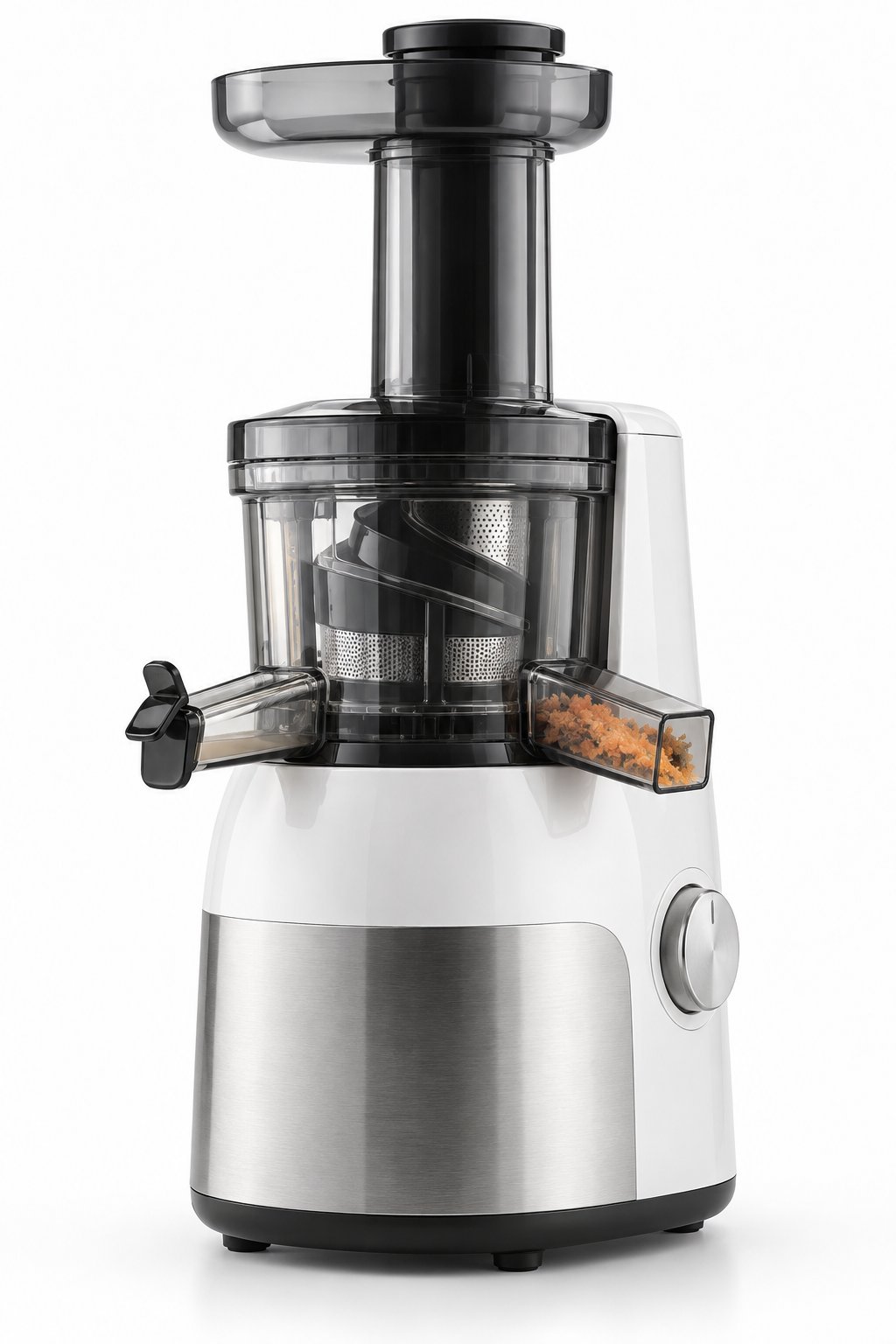
A masticating juicer, often called a slow juicer, replaces the spinning basket with a single rotating auger inside a tapered or cylindrical screen. The auger turns slowly — on the ZY-SJ100 the motor speed is 80 RPM — and moves produce downward while crushing it against the screen and pressing it through fine openings.
There is no shredding disc and no fast air movement inside the chamber. Extraction is progressive: material is conveyed, compressed and squeezed along the length of the auger, and pulp exits through a separate discharge port into a pulp container. Because the auger turns slowly and the motor is geared down, the dominant noise source is reduced — the ZY-SJ100 is specified below 60 dB.
Why the Industry Cites Lower Heat and Oxidation
The rationale most manufacturers and technical writers give for low-speed extraction is straightforward and worth understanding before you write your own product copy.
- Less frictional heat. A slow-turning auger does less work against the produce per unit of time than a shredding disc. Less mechanical friction means less heat generated in the juice during extraction.
- Less aeration. A sealed, slow-moving chamber introduces less air into the liquid than a spinning basket. Oxidation reactions in juice depend on contact with oxygen, so reduced aeration is the mechanism behind the claim that slow-juiced product keeps better.
- More complete pressing of low-yield produce. Leafy greens, wheatgrass and soft herbs release relatively little liquid under shredding alone. A crushing-and-pressing action keeps the material in the chamber longer and squeezes it more thoroughly, which is why this category is usually positioned for those inputs.
- Drier pulp. Because the material is compressed rather than flung, the discharged pulp is generally drier — a visible indicator buyers can judge on a sample.
These are mechanism-based explanations, not measured outcomes. No specification sheet can tell you the yield or retention performance of a machine in your market's typical usage. That is a sample-test question, covered below.
Which Specifications Actually Matter When Comparing Models
Slow juicers are compared across a small set of specifications that map directly to user experience, compliance and manufacturing cost. Each one below ends with what a buyer should verify with the supplier.
Motor speed (RPM)
RPM is the defining figure for this category: it separates masticating designs from centrifugal ones and, within masticating designs, indicates how gently the auger treats the produce. A lower RPM generally corresponds to a slower feed and a longer residence time in the chamber.
Verify with the supplier: confirm the RPM figure is the auger/motor output speed under load, not an unloaded nominal value, and ask what feed rate the design targets.
Motor power
Power should be read together with RPM, not on its own. A slow juicer trades rotational speed for torque, so a modest wattage can still drive a large auger through fibrous material. The ZY-SJ100 is rated at 150 W.
Verify with the supplier: ask how the motor behaves under continuous load with hard produce, and whether the design includes thermal protection.
Feeding chute width
Chute diameter determines how much pre-cutting the user does. A 75 mm chute on the ZY-SJ100 accepts a substantial proportion of whole produce, which shortens preparation time — a real selling point in retail listings.
Verify with the supplier: match the chute width against the produce sizes your target market typically juices, and check whether an additional smaller feed opening is provided for leafy items.
Auger material
The auger is the part in continuous contact with food, so its material is a food-safety and durability question rather than a marketing one. The ZY-SJ100 uses a food-grade Tritan auger.
Verify with the supplier: request the material declaration and confirm it is the same grade used in production samples.
Juice cup and pulp cup capacity
Cup volumes affect how many servings a user can process before emptying — a practical differentiator in retail comparison charts. The ZY-SJ100 ships with a 600 ml juice cup and an 800 ml pulp cup.
Verify with the supplier: confirm cup capacities are the delivered set, and that the pulp cup is sized to match the pulp output of a full juice-cup cycle.
Noise level
Noise is one of the clearest consumer-visible advantages of low-speed extraction and is worth quoting accurately. The ZY-SJ100 is specified below 60 dB.
Verify with the supplier: ask under what measurement conditions the figure was obtained, and confirm it for the voltage variant you intend to order.
Voltage and market matching
A single juicer platform is normally offered in more than one electrical configuration. The ZY-SJ100 is available in 220–240 V / 50 Hz for EU markets and 120 V / 60 Hz for US markets.
Verify with the supplier: confirm the plug type, cord length and any region-specific documentation for each variant you intend to import.
Housing, dimensions and weight
Housing construction and physical size drive packaging, shelf presence and shipping cost. The ZY-SJ100 uses an ABS + stainless steel housing and measures 280 x 180 x 420 mm at 4.2 kg net.
Verify with the supplier: request carton dimensions and gross weight for the exact configuration you plan to list, since these determine your freight calculation.
Cleaning and removable parts
On the ZY-SJ100 the removable parts are dishwasher-safe, which is a standard point of comparison in retail copy.
Verify with the supplier: confirm which parts are removable and whether any of them require hand washing.
Certification scope
Certification is a compliance question first and a marketing question second. For the ZY-SJ100, CE, RoHS and LFGB are available upon request. Confirm precisely which documents apply to your model, voltage variant and destination market before publishing any compliance claim.
Worked Example: ZY-SJ100 Specification Table
The table below collects the ZY-SJ100's published specifications so you can see how the comparison points above appear on a real product sheet. Use it as a template for structuring your own supplier comparison.
| Specification | Value | What to verify with the supplier |
|---|---|---|
| Motor speed | 80 RPM | Loaded vs unloaded measurement; target feed rate |
| Power | 150 W | Continuous-load behaviour; thermal protection |
| Feeding chute | 75 mm wide | Fit against typical produce sizes in your market |
| Auger material | Food-grade Tritan | Material declaration; same grade as production samples |
| Juice cup | 600 ml | Delivered set configuration |
| Pulp cup | 800 ml | Matched to a full juice-cup cycle |
| Housing | ABS + stainless steel | Finish options for your private label |
| Noise | Below 60 dB | Measurement conditions; per voltage variant |
| Voltage | 220–240 V / 50 Hz (EU); 120 V / 60 Hz (US) | Plug type, cord length, regional documentation |
| Dimensions | 280 x 180 x 420 mm | Carton size and gross weight for freight |
| Net weight | 4.2 kg | Weight for the exact ordered configuration |
| Certification | CE, RoHS, LFGB — available upon request | Which documents apply to model, voltage and market |
| Removable parts | Dishwasher-safe | Which parts require hand washing |
How to Evaluate a Slow Juicer Sample
Specifications narrow the field; a sample decides it. The following points are the ones that a specification sheet cannot answer, so plan to resolve them before committing to a program.
- Compare pulp dryness. Run the same produce through each candidate and compare the discharged pulp. Drier pulp indicates more complete pressing.
- Ask for measured yield. Request that the supplier measure juice output against input weight under a defined recipe. Treat any percentage you receive as supplier-reported data tied to those test conditions, and reproduce the test yourself if the number matters commercially.
- Test the difficult inputs. Leafy greens, wheatgrass and fibrous root vegetables are the inputs this category is usually bought for. Test them first, not last.
- Check the cleaning routine end to end. Time how long disassembly, rinsing and reassembly actually take.
- Confirm voltage and plug for your market. Order the correct variant at sample stage so your compliance review matches what you will import.
- Review documentation with the sample. Match certification documents to the model and voltage variant on the nameplate.
Working with an OEM/ODM Slow Juicer Manufacturer
The ZY-SJ100 is manufactured by Guangdong Zhiyue Electric Co., Ltd., an OEM/ODM kitchen appliance manufacturer serving Europe and North America. For private-label and retail-chain programs, the platform supports OEM/ODM customization of finish, cup capacity, control layout and branding.
Commercial terms for this model: minimum order quantity of 500 units, with a lead time of 30–45 days after sample approval. Certification documents (CE, RoHS, LFGB) are available upon request, and removable parts are dishwasher-safe.
If you are evaluating this platform for a slow juicer program, the practical next step is to request a sample in the voltage variant for your target market and specify which of the customization areas you intend to change. Full product information is available on the ZY-SJ100 product page.
Frequently Asked Questions
What is the main difference between a slow juicer and a centrifugal juicer?
A centrifugal juicer shreds produce against a high-speed spinning basket; a slow juicer crushes and presses it with a slow-turning auger. The mechanism, not the brand, determines noise, pulp dryness and behaviour with leafy inputs.
Does a slow juicer use less power than a centrifugal juicer?
Not necessarily. A slow juicer trades rotational speed for torque, so wattage alone is not a reliable comparison. Read power together with RPM. The ZY-SJ100 is rated at 80 RPM and 150 W.
Why do slow juicers handle leafy greens better?
Leafy greens and wheatgrass release little liquid under shredding alone. A crushing-and-pressing action keeps the material in the chamber longer and compresses it more thoroughly. Confirm this on a sample with your own produce.
What chute width should I look for?
It depends on how much pre-cutting your target consumer will accept. A 75 mm chute, as on the ZY-SJ100, accepts a substantial proportion of whole produce. Match chute size to the produce sizes typical in your market.
Can the ZY-SJ100 be customized for our brand?
OEM/ODM customization covers finish, cup capacity, control layout and branding. Minimum order quantity is 500 units, and lead time is 30–45 days after sample approval. Confirm your specific requirements at sample stage.