There is no single best drip coffee maker — "best" depends on four spec-sheet criteria: carafe capacity and cup-count standard, programmable timer, keep-warm plate behavior, and how much the platform supports OEM customization. This guide shows how to compare each criterion, using the ZY-CM300 12-cup programmable drip coffee maker as a worked benchmark, and flags which specs buyers must confirm with the supplier before ordering.
Selection Guide for Retail and Private-Label Buyers
"Best" is not a product name. For a buyer sourcing drip coffee makers for a retail chain, distributor or private-label program, the best model is the one whose spec sheet matches your market's expectations on four points you can actually verify: carafe capacity and how cup count is stated, programmable timer, keep-warm plate, and how much of the platform the factory will customize under your brand. Everything else is marketing.
This guide explains how to read each criterion, then uses one factory model — the ZY-CM300, a 1.2 L 12-cup programmable drip coffee maker with keep-warm — as a worked benchmark. All figures below are factory-declared specifications for that model. Where a spec affects the buying decision but is not part of the declared data, we say so and flag it as a question for the supplier rather than filling the gap.
Key Takeaways
- Compare carafe capacity in litres first, then check how "cups" are defined — cup sizes differ between brands and markets.
- A programmable timer is only useful if it survives the label and instruction manual you ship in each market.
- Keep-warm is a feature you can verify exists; its temperature and hold duration are separate specs to confirm in writing.
- For OEM programs, the best platform is the one the factory can already modify in capacity, finish, control layout and branding.
- The ZY-CM300 benchmark: 1.2 L / 12 cups, 900 W, 24-hour programmable timer, MOQ 500 units, lead time 30–45 days after sample approval.
In this article
Capacity and Cup Count: Compare Litres, Not Cups
Capacity is the first filter because it decides which shelf and which consumer the product is for. A 1.2 L carafe serves a household; a smaller carafe targets single or dual users. The trap is that "cup" has no single standard across brands. One supplier's 12-cup carafe and another's 12-cup carafe can hold different volumes even though the box claims look identical.
What to compare
- Carafe volume in litres or millilitres, printed on the spec sheet, not the marketing name.
- The cup count the brand intends to claim, and whether it is consistent with the litre figure.
- Carafe material and whether it is replaceable as a spare part — a retail program will eventually need spares.
- Reservoir design: a removable water reservoir with capacity markings makes filling and cleaning easier to explain in the manual and reduces returns.
What the benchmark model shows
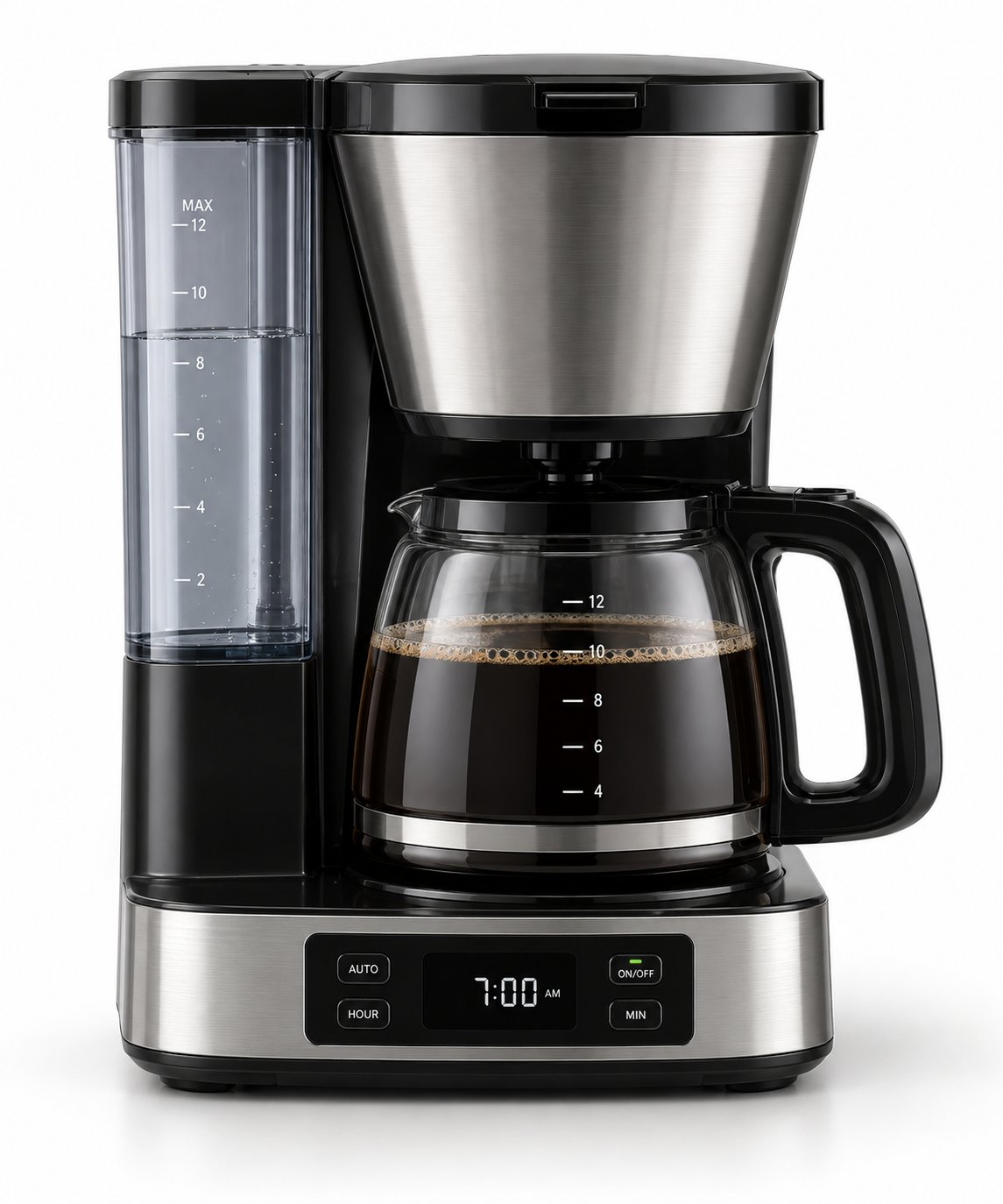
The ZY-CM300 uses a 1.2 L glass carafe rated at 12 cups, a removable filter basket with a permanent filter, and a removable water reservoir with capacity markings. Its dimensions are 260 × 220 × 320 mm and net weight is 2.3 kg — figures you need before designing retail packaging and calculating carton quantities. The full product page is at /product-drip-coffee-maker.
What to confirm with the supplier
Ask how the supplier defines one cup on its own spec sheet, and at what fill level the 12-cup rating is measured. Ask whether a different carafe volume can be tooled for your program, and whether the glass carafe and permanent filter are available as after-sales spares. Volume definitions are a documentation issue, not a performance claim — get it in writing before artwork is finalized.
Programmable Timer: Useful Only If It Travels With the Product
A programmable timer is one of the most common reasons a shopper chooses one drip coffee maker over another, which makes it a specification worth hardening rather than assuming. The declared feature is simple; the operational detail around it is what ends up on your support line.
What to compare
- Programming window — 24-hour timers are the common retail benchmark, so confirm the figure rather than assuming it.
- Control layout: rotary dial, membrane buttons or digital display. This affects perceived value, tooling and how the packaging illustration must look.
- Clock retention during short power interruptions, which matters in markets with unstable power.
- Manual language and symbol conventions, since a timer that cannot be set from the shipped manual generates returns.
What the benchmark model shows
The ZY-CM300 carries a 24-hour programmable timer and a 900 W heating circuit. Its control layout is part of the platform that can be customized for OEM programs, which is discussed below. Step-by-step timer setup instructions are a separate topic and are covered elsewhere on this site; here the point is simply that the timer must be specified and documented before you approve a sample.
What to confirm with the supplier
Confirm the programming window in writing, the control type you want for your market, and whether the printed manual and on-product symbols can be supplied in your required languages. Ask what happens to the timer setting after a power cut, and treat the answer as a spec to approve on the sample — not as an assumption from a general product description.
Keep-Warm Plate: Verify the Feature, Then Ask the Follow-Up Questions
Keep-warm is often listed as a yes/no feature when it is really two specifications: the plate exists, and how it behaves. Buyers should separate the two, because the first is easy to verify and the second is where disputes originate.
What to compare
- Presence of a keep-warm plate, confirmed on the sample rather than on the box copy.
- Whether the plate is switchable or tied to the brew cycle, since this changes the manual and the safety section.
- Whether the carafe sits on the plate with enough contact for the feature to mean anything in practice.
- Any market-specific labelling that applies when a heating element remains on after brewing.
What the benchmark model shows
The ZY-CM300 is specified with a keep-warm plate and a glass carafe. Those two facts are declared; the plate's surface temperature, hold duration and auto-off behaviour are not part of the declared data used here, so they should be requested as separate specifications if your market or your retail partner requires them. The same applies to any energy-consumption figure you may want for packaging claims.
What to confirm with the supplier
Confirm hold duration and auto-off behaviour, whether the plate can be switched off independently, and which safety marking the product carries for your destination market. Certifications listed for this model are CE, RoHS and LFGB, available upon request — treat them as documents to be verified against your target market and your own compliance process, and confirm voltage at order: the model is offered at 220–240 V / 50 Hz for the EU and 120 V / 60 Hz for the US.
OEM Customization Potential: The Criterion Most Buyers Underweight

Two suppliers can quote an identical-looking drip coffee maker and be very different partners, because the difference is in how much of the platform they can change without rebuilding the tooling. For a private-label program, this is the criterion that decides whether a product is merely available or genuinely suitable.
What to compare
- Which elements are customizable: capacity, finish, control layout and branding are the usual four.
- Minimum order quantity per configuration, since each colour or control variant is effectively its own SKU.
- Whether sample development is part of the standard workflow or treated as an exception.
- How quality control and export delivery are handled once the sample is approved.
What the benchmark model shows
For the ZY-CM300, OEM/ODM customization covers capacity, finish, control layout and branding. The declared commercial terms are MOQ 500 units and lead time 30–45 days after sample approval. The supplier supports programs from requirement review and sample development through production, QC and export delivery — meaning a buyer can enter at the requirement-review stage rather than arriving with a finished drawing.
What to confirm with the supplier
Confirm the MOQ for your specific configuration rather than the platform generally, since finish changes can affect it. Confirm which certifications are available for your destination market, at what point sample approval is locked, and how packaging artwork deadlines relate to the production schedule. If your program needs a carton or pallet specification, raise it during requirement review, not after sampling.
Benchmark Spec Table: ZY-CM300
| Specification | Declared value |
|---|---|
| Carafe capacity | 1.2 L glass carafe, rated 12 cups |
| Power | 900 W |
| Programmable timer | 24-hour |
| Keep-warm | Keep-warm plate |
| Filter | Removable filter basket with permanent filter |
| Water reservoir | Removable, with capacity markings |
| Voltage / frequency | 220–240 V / 50 Hz (EU) or 120 V / 60 Hz (US) |
| Dimensions | 260 × 220 × 320 mm |
| Net weight | 2.3 kg |
| Certifications | CE, RoHS, LFGB — listed as available upon request |
| MOQ | 500 units |
| Lead time | 30–45 days after sample approval |
| OEM/ODM scope | Capacity, finish, control layout, branding |
How OEM Customization Redefines "Best"
When you are sourcing for your own label, the four criteria stop being product questions and become program questions. The model that is best for a European discount chain is rarely the model that is best for a North American specialty retailer, even when both sit on the same platform.
A short worked example makes this concrete. Suppose your requirement is a private-label 12-cup drip coffee maker for the EU market with a 220–240 V / 50 Hz configuration and your own branding. Against the benchmark platform, that requirement maps onto the declared scope directly: the voltage configuration exists, branding is within the customization scope, and the MOQ and lead-time figures apply. What the requirement does not automatically settle is whether your chosen finish or control layout changes the MOQ, or whether the certifications you need for your specific market and retail partner are already in place. Those two questions are where a program succeeds or stalls, so raise them at requirement review.
This is also why a generic buying guide for all coffee makers is not enough for a sourcing decision. A drip coffee maker has a carafe, a filter basket, a reservoir, a timer and a warming plate; each of those is a specification your buyer can compare, and each is a place where a private-label program can differentiate. The narrower comparison is the more useful one.

Production planning matters because the customization options you choose change what has to be scheduled: a different finish, a different control layout or different branding each affect tooling, materials and packaging before anything ships.
Next Step for Sourcing Inquiries
If you are comparing drip coffee makers for a retail, distribution or private-label program, the most efficient way to start is to send the four decision points in writing: your target carafe capacity and how you define cup count for your market; the timer programming window and control type you want; your keep-warm and auto-off requirements plus the safety marking your market needs; and your customization scope — capacity, finish, control layout and branding — with your target voltage. Include your expected order quantity so the MOQ for your specific configuration can be quoted rather than estimated.
With those points in hand, the supplier can review the requirement against the platform, advise which certifications are available for your destination market, and move to sample development on a defined specification instead of a general product description. To begin, request a quote or a sample and set out the four criteria above for the ZY-CM300 platform or the closest match in the range.