A trade buyer's decision framework for sourcing electric rice cookers: compare factory-direct OEM/ODM, importer/wholesaler, and marketplace channels on control, consistency, documentation, and after-sales. Includes a verification checklist and FAQ for first orders.
Sourcing Channels
If you are sourcing electric rice cookers for import, distribution, or private-label retail, the first decision is not which model but which channel. The same 1.8 L, 500 W appliance can reach your warehouse through a factory OEM/ODM program, an importer or wholesaler, or a marketplace seller. Each route trades control for convenience in a different way. This article lays out what each channel gives you, what it costs you, and the checks to run before a first order.
Key takeaways
- Factory-direct gives the most control over specifications, revisions, and documentation, but requires more of your own import and quality resources.
- Importers and wholesalers reduce paperwork and lead time risk, but you inherit their model choices and revision schedule.
- Marketplaces are fast for small volumes, yet rarely give you control over the exact model revision or full technical file.
- Whatever the channel, confirm voltage, plug type, packaging, and the model revision in writing before you pay.
Three channels, one appliance

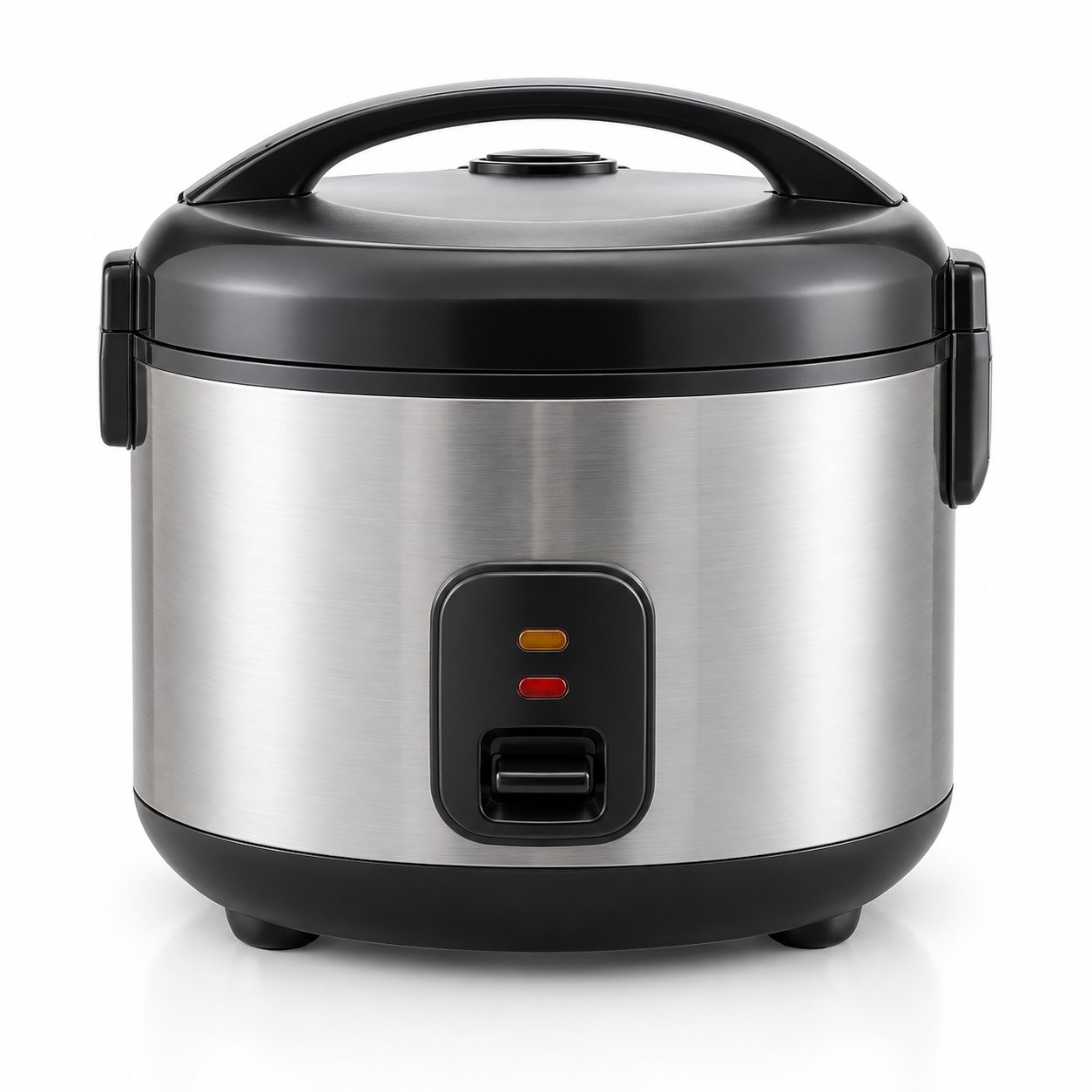
Take a representative product: a 1.8L 500W Electric Rice Cooker with Non-Stick Inner Pot. It has a one-touch switch with indicator, overheat protection, a secure locking lid, and a non-stick coated inner pot. It runs on 220-240 V and is available for OEM/ODM customization. Those facts are the same in every channel. What changes is who controls the specification, who holds the technical file, and who answers when a container arrives with a mismatched plug or a revised inner pot coating.
Channel comparison
| Dimension | Factory-direct OEM/ODM | Importer / Wholesaler | Marketplace Seller |
|---|---|---|---|
| Specification control | High: you define capacity, voltage, plug, packaging, and branding | Low to medium: choose from the importer's existing range | Low: the listing is the specification |
| Model revision consistency | Controlled through your own approval and change notices | Depends on the importer's stock rotation | Rarely guaranteed; listings can change without notice |
| Documentation | You request and hold the technical file, test reports, and label artwork | Ask the importer to list which of these items they hold before you order | Minimal; often a PDF spec sheet only |
| Import paperwork | Your responsibility or your forwarder's | Usually handled by the importer | Varies by seller; often the buyer's responsibility |
| After-sales | Direct with the manufacturer; terms set in the supply agreement | Through the importer's return policy | Platform dispute process; parts availability uncertain |
| Best fit | Private-label programs, distributors building a brand | Buyers testing a category without import infrastructure | Small initial volumes or urgent replenishment |
What factory-direct actually buys you
A factory OEM/ODM program such as the one offered by Guangdong Zhiyue Electric Co., Ltd. covers requirement review, sample development, production, quality control, and export delivery. In practice, that means you can specify the 220-240 V configuration for your market, choose the plug, define the retail carton and manual language, and lock the model revision before mass production. Quality control runs through production and final inspection, and the approved specification sheet is the reference for final inspection. That is the concrete difference from a marketplace listing: you approve a document, and the units are checked against it.
The cost is your own workload. You or your agent handle import clearance, you review the technical file, and you decide how much testing to commission. MOQ and lead time are not fixed in a catalog; they must be confirmed in the quotation for your specific configuration. That is normal for OEM work, but it means you cannot compare factory quotes on unit price alone.
When an importer or wholesaler is the better channel
If you are adding rice cookers to a broader kitchen appliance range and do not want to manage a factory relationship, an importer removes most of the friction. They already hold stock, handle customs, and can ship mixed containers. The trade-off is that you buy their specification, not yours. If they switch suppliers or revise the inner pot coating between shipments, your shelf product changes without your approval. Ask for the importer's source factory and the revision history before committing to a repeat order, and ask them to state in writing which technical documents they can pass on to you.
Marketplace sellers: fast, but thin on control
Marketplace listings are useful for samples, small trial volumes, or urgent gaps. They are a weak foundation for a private-label program. A listing rarely gives you control over the exact model revision, the technical file behind any compliance mark shown, or spare parts supply. Treat a marketplace purchase as a sample source, not as a supply chain, unless the seller can name the manufacturer and provide the documentation you need.
Checks before a first order
Whichever channel you choose, the verification work is similar. Run these checks before paying a deposit.
- Sample first. Request a production-representative sample, not a hand-built prototype. Test the one-touch switch, the locking lid, and the non-stick pot surface, then keep the sample as your reference standard.
- Confirm the model and voltage in writing. The 1.8 L, 500 W, 220-240 V configuration must appear on the quotation and the carton artwork. Specify the plug standard for your destination market and confirm it is the one that will ship.
- Clarify who handles import paperwork. Factory-direct means you or your forwarder; importer channels usually include it. Get this in the quotation, not in a chat message.
- Agree on revision control. Ask how the supplier notifies you of changes to components, coating, or packaging, and put the answer in the supply agreement.
- Confirm MOQ, lead time, and payment terms in the quotation. These vary with configuration and order size; do not assume a standard figure.
FAQ
Can I get a sample before placing an order?
Yes. Ask for a sample built to the same specification as mass production, and confirm whether the sample cost is credited against the first order. Keep the approved sample as the reference for inspection.
Who handles the import paperwork?
It depends on the channel. With a factory-direct order, you or your freight forwarder handle clearance and import documentation. With an importer, they usually manage it. With a marketplace seller, confirm explicitly, because responsibility often sits with the buyer.
What should I verify about the model and voltage?
Confirm the capacity (1.8 L), power (500 W), voltage range (220-240 V), plug type, and control configuration on the quotation and on the retail carton. If your market requires a different voltage, ask whether it is available as an OEM/ODM option before assuming it is.
What must be confirmed in writing?
Model revision, voltage and plug, packaging and manual language, MOQ, lead time, payment terms, inspection arrangement, and after-sales terms. Verbal assurances do not survive a change of production batch.
Next step
If you are evaluating a private-label or distributor program, start with a requirement review rather than a price request. Send your target market, voltage and plug standard, packaging needs, and volume estimate, and ask for a sample and a quotation that states MOQ and lead time for that configuration. That gives you a comparable basis for deciding between factory, importer, and marketplace.